
Vanki Rings in Lab Grown Diamonds: Meaning, History and Modern Styling
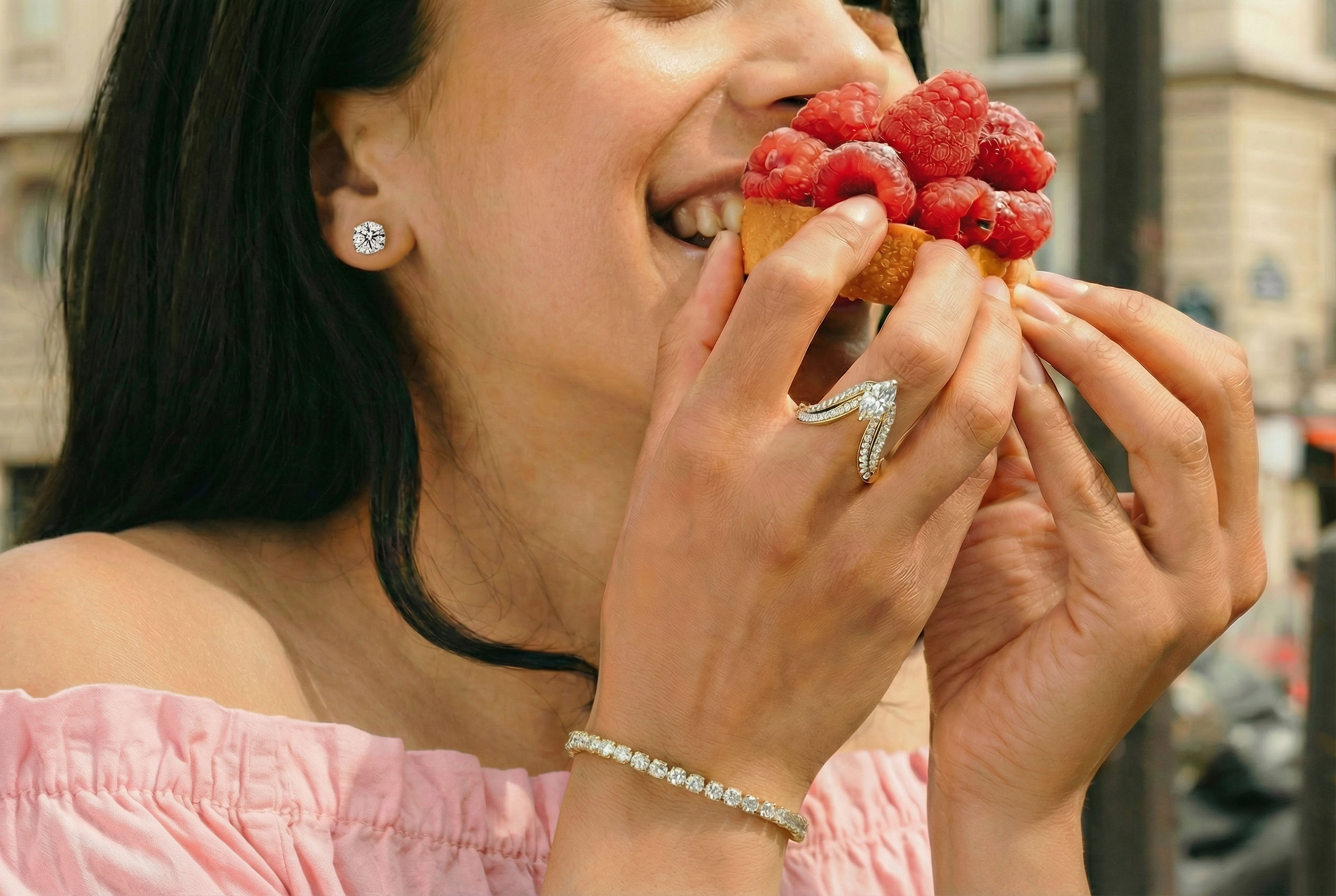
A vanki ring is a V-shaped finger ring inspired by the traditional South Indian armlet of the same name. Once closely associated with bridal jewellery and ceremonial dressing, the design now appears in slimmer gold and diamond rings that you can wear with everything from a silk sari to a white shirt.
You may also know it as the Aishwarya Rai ring. Searches for “vanki ring Aishwarya Rai” grew around the distinctive diamond-studded V-shaped ring she has been photographed wearing, but the design’s history began long before celebrity wardrobes and social media close-ups.
Its appeal is easy to understand. The pointed silhouette looks traditional without feeling heavily ornamental, and it gives a familiar diamond ring a direction, quite literally.
What is the vanki ring meaning?
The vanki ring's meaning comes from the traditional V-shaped armlet worn in South Indian jewellery, particularly for weddings, classical dance and important ceremonies.
The original vanki is an upper-arm ornament rather than a finger ring. It curves downwards into a central point, often decorated with temple motifs, floral work, peacocks, deities or gemstones. The finger-ring version borrows that recognisable V-shaped structure and reduces it to a scale that works on the hand.
The shape is frequently associated with grace, prosperity, protection and cultural continuity. Its precise meaning, however, isn’t identical across every South Indian family or community. Jewellery traditions often travel through regions and generations, collecting different names and customs as they go.
That distinction matters. A modern V-shaped diamond ring may be inspired by the vanki without carrying the ceremonial role of a traditional bridal ornament.
Term | What it usually refers to |
Vanki | A traditional V-shaped South Indian upper-arm ornament |
A finger ring inspired by the pointed vanki silhouette | |
V-shaped ring | A general design description without a necessary cultural meaning |
A modern geometric ring with a pointed or zigzag band | |
Wishbone ring | A curved V-shaped ring often designed to sit beside another ring |
A vanki ring and a chevron ring can look similar, but the difference is context. “Chevron” describes the geometry. “Vanki” connects that geometry to an established South Indian jewellery form.
Where did the vanki design come from?
The vanki design developed as a traditional South Indian arm ornament and became especially visible through bridal dress, temple jewellery and classical dance costumes.
Traditional versions are usually crafted in gold and may feature repoussé work, rubies, emeralds, pearls or detailed religious motifs. The shape follows the upper arm, with its central point directed downwards. This creates a strong line while leaving enough movement for the wearer.
Temple jewellery helped preserve the form visually. Bharatanatyam and Kuchipudi dancers often wear armlets as part of a complete jewellery set, allowing the vanki silhouette to remain recognisable even as everyday jewellery became lighter and less ceremonial.
The modern ring isn’t a direct miniature copy in every case. Designers often extract one element, usually the descending V, and translate it through diamonds, open space or curved bands.
That translation is why today’s vanki rings can look remarkably varied:
Modern interpretation | Design character |
Plain gold V | Clean and minimal |
Single diamond curve | Delicate and easy to stack |
Sparkling across the full V | |
Closer to traditional ornamental styles | |
Graphic and contemporary | |
Light, sculptural and less formal | |
Statement-led without heavy metalwork |
The design has survived because its underlying line is so adaptable. Remove the temple motifs and it becomes geometric. Add diamonds and it becomes an evening ring. Place it beside a solitaire and it becomes part of a modern ring stack.
Has Aishwarya Rai ever worn a vanki ring?
Yes, Aishwarya Rai Bachchan has repeatedly been photographed wearing a distinctive V-shaped diamond ring that fashion publications and jewellery writers identify as a vanki-style ring.
The ring is usually seen on her ring finger and has become so closely associated with her that “vanki ring Aishwarya Rai” and “Aishwarya Rai V-shaped ring” now function almost as jewellery categories online. The Times of India, Free Press Journal and other publications have discussed the ring and its traditional associations.
Some reports describe it as connected to marriage and Aishwarya Rai Bachchan’s Mangalorean or South Indian roots. She was born in Mangalore and comes from a Tulu-speaking Bunt family, a detail often used to explain the cultural association made by jewellery and entertainment publications.
So the accurate answer is this: she has worn a diamond-studded V-shaped ring widely identified as a vanki, but claims about its precise private meaning should be treated as interpretation rather than a direct quote from her.
That hasn’t stopped it becoming influential. The ring showed women that the V-shaped form could be worn without an entire traditional jewellery set. It worked with saris, evening gowns and everyday appearances, quietly moving the vanki from the bridal cupboard to the modern ring tray.
Why vanki rings work so well with diamonds
Vanki rings work well with diamonds because the angled band creates visible movement while allowing each stone to follow the natural line of the finger.
A straight diamond band creates a horizontal line. A vanki draws the eye towards a point, which can make the finger appear longer and give even a delicate ring more presence.
The shape also gives designers several ways to place diamonds. Round diamonds can trace the curve for consistent sparkle. Pear or marquise diamonds can emphasise the pointed structure. A larger centre stone can sit at the base of the V, while smaller stones rise along either side.
Diamond arrangement | Visual effect |
Even, continuous sparkle | |
Graduated diamonds | Draws attention towards the centre |
Strengthens the pointed silhouette | |
Adds a leaf-like, traditional quality | |
Diamond only at the tip | Minimal with one clear focal point |
Double diamond curve | Creates depth without a heavy setting |
A vanki ring can therefore look elaborate without needing a very large centre diamond. The shape itself supplies part of the drama.
Why choose a vanki ring in lab grown diamonds?
A vanki ring in lab grown diamonds combines a recognisably Indian design with real diamonds created in a controlled environment rather than extracted from the earth.
Lab grown diamonds have the same chemical, physical and optical properties as mined diamonds. They aren’t imitation stones or diamond substitutes. Their difference lies in origin.
This is particularly useful for vanki designs because many of them use several diamonds across a curved band. Lab grown diamonds allow you to consider more detailed stone placement, broader coverage or larger visible proportions while still choosing real diamonds.
They can also make the ring easier to treat as everyday jewellery rather than a piece that feels too precious to leave the locker.
The design possibilities include:
a slim diamond V for daily wear;
a fuller pavé curve for celebrations;
a double vanki that frames another ring;
a floral interpretation inspired by temple jewellery;
a centre-led design using pear or marquise diamonds;
a clean geometric ring in yellow, white or rose gold.
The decision should still come down to craftsmanship. Look closely at how evenly the diamonds follow the curve, whether the pointed centre sits straight and whether the band feels smooth between the fingers.
How is a modern vanki ring different from a traditional one?
A modern vanki ring keeps the recognisable V-shaped line while reducing the weight, ornamentation and ceremonial detailing of traditional vanki jewellery.
Traditional pieces often use yellow gold, coloured gemstones, floral forms and temple-inspired motifs. Modern versions are more likely to use open space, fine diamond lines, white or rose gold and simplified settings.
Traditional influence | Modern interpretation |
Heavy yellow gold | Slimmer gold construction |
Temple or deity motifs | Abstract curves and clean geometry |
Rubies, emeralds and pearls | Diamonds or a restrained colour palette |
Bridal and ceremonial styling | Everyday, office and occasion wear |
Dense ornamentation | Negative space and lighter settings |
Full matching jewellery set | Worn alone or within a ring stack |
Neither version is more authentic as a personal choice. They serve different wardrobes.
A traditional design may make sense when you want jewellery that speaks clearly to cultural dress. A modern lab grown diamond vanki is easier to wear when you want the reference to be present but not costume-like.
How should a vanki ring fit?
A vanki ring should sit straight on the finger, with the central point aligned neatly rather than repeatedly rotating to one side.
The fit deserves extra attention because the top of the ring isn’t symmetrical in the same way as a plain circular band. If it’s too loose, the V may turn sideways and lose its visual effect. If it’s too tight, the pointed top can make the finger appear compressed.
Check the ring while your hand is relaxed and while making a fist. The edges shouldn’t dig into the neighbouring fingers, and any pointed sections should be softened by the setting.
A wider or more diamond-heavy vanki may require a slightly different size from your narrow everyday rings. Try the exact design rather than assuming your usual size will always translate.
The orientation is flexible. You can wear the point facing towards the fingertip for an elongating effect or turn it towards the hand for a crown-like appearance. There’s no universal rule, although the downward-pointing arrangement most closely echoes the traditional armlet silhouette.
How to style a diamond vanki ring
A diamond vanki ring can be styled alone as a quiet statement or used to frame solitaires, bands and other curved rings.
Worn alone, it creates enough shape to make the hand look styled without requiring several rings. This works particularly well with officewear, a silk kurta or a plain sari where the jewellery needs to feel considered rather than elaborate.
For a ring stack, use the V as a frame. A solitaire can sit inside its open curve, creating the appearance of a custom ring set. A plain gold band can add contrast, while a second vanki facing the opposite direction creates a diamond-shaped space in the middle.
Styling idea | How it works |
Wear it alone | Keeps attention on the V-shaped silhouette |
Pair with a solitaire | Frames the centre diamond |
Add a plain band | Balances sparkle with clean gold |
Stack two vankis | Creates a geometric diamond outline |
Mix gold colours | Makes the stack feel collected, not matched |
Wear on the index finger | Gives a traditional form a fashion-led edge |
You don’t have to reserve it for ethnic wear. A modern vanki ring looks especially sharp beside tailoring because the curved diamonds interrupt the clean lines of the outfit.
With a heavily embroidered look, let the ring stand alone rather than surrounding it with several detailed bands. With simpler clothing, you can build a fuller stack.
Is a vanki ring only for married women?
A modern vanki ring isn’t restricted to married women, although some culturally specific V-shaped rings may carry marital significance within particular communities.
This is where two ideas often become tangled. The broader vanki-inspired ring is a jewellery design that anyone can choose. A particular ring worn as part of a community’s marriage customs may have a more specific meaning.
When you buy a contemporary diamond vanki for its shape, you aren’t automatically claiming a marital status. You’re wearing a modern ring inspired by an established Indian jewellery form.
It helps to understand the history rather than flattening every pointed ring into “the Aishwarya Rai ring”. The celebrity reference may help you recognise it, but the vanki belongs to a much larger design tradition.
A familiar shape with somewhere new to go
The vanki ring doesn’t need to choose between heritage and modernity. Its most interesting quality is that it already contains both.
The V gives it history, but it also makes the ring graphic, stackable and unexpectedly easy to wear. Lab grown diamonds take that adaptability further, allowing the shape to become lighter, brighter and more suited to jewellery you reach for regularly.
Ethera’s vanki ring keeps the cultural reference visible without turning it into a museum piece. It isn’t trying to replace the traditional ornament. It simply gives its most recognisable curve another place to live.
Frequently Asked Questions
What is the meaning of a vanki ring?
A vanki ring is a V-shaped finger ring inspired by the traditional South Indian upper-arm ornament called a vanki. The design is commonly associated with grace, prosperity, protection and cultural heritage. Modern versions may be worn simply for their distinctive shape without carrying a ceremonial or marital meaning.
Has Aishwarya Rai ever worn a vanki ring?
Yes, Aishwarya Rai Bachchan has often been photographed wearing a diamond-studded V-shaped ring widely described as a vanki-style ring. Several fashion and jewellery publications connect it to her South Indian background and marriage, although she doesn’t appear to have publicly confirmed the ring’s exact personal meaning herself.
Why is the vanki ring associated with Aishwarya Rai?
The vanki ring is associated with Aishwarya Rai because she has repeatedly worn a recognisable V-shaped diamond ring in public appearances. Its unusual silhouette drew attention online, leading many shoppers to search for it as the “Aishwarya Rai ring”, even though the original vanki design predates her by generations.
Can unmarried women wear vanki rings?
Yes, unmarried women can wear modern vanki rings as fashion jewellery. While certain V-shaped rings may have marital significance in specific South Indian communities, contemporary vanki-inspired designs are widely worn for their shape and styling possibilities. Understanding the cultural origin lets you appreciate the design without treating every version as a marital symbol.
Are lab grown diamond vanki rings real diamond rings?
Yes, lab grown diamond vanki rings contain real diamonds with the same chemical, physical and optical properties as mined diamonds. They’re created in a controlled environment rather than extracted from the earth. Ask for clear diamond specifications, gold purity details and certification where relevant before choosing your ring.
Which finger is best for wearing a vanki ring?
A vanki ring can be worn on any finger where it sits comfortably and remains properly aligned. The ring finger gives it a traditional appearance, while the middle or index finger makes the design feel more contemporary. Choose a close fit because the pointed silhouette becomes less effective if the ring rotates.
Which way should a vanki ring point?
A vanki ring can point towards the fingertip or towards the hand, depending on the design and the effect you prefer. Pointing towards the fingertip visually lengthens the finger and echoes the downward curve of the traditional armlet. Turning it around can create a crown-like frame for another ring.
Can you stack a vanki ring with a solitaire?
Yes, a vanki ring can be stacked with a solitaire when its curve leaves enough room around the centre setting. The V can frame a round, oval, pear or marquise diamond and make the combination look intentionally designed. Check that the two rings don’t rub against each other’s stones or prongs.