
6 rings that don't scream “engagement ring”
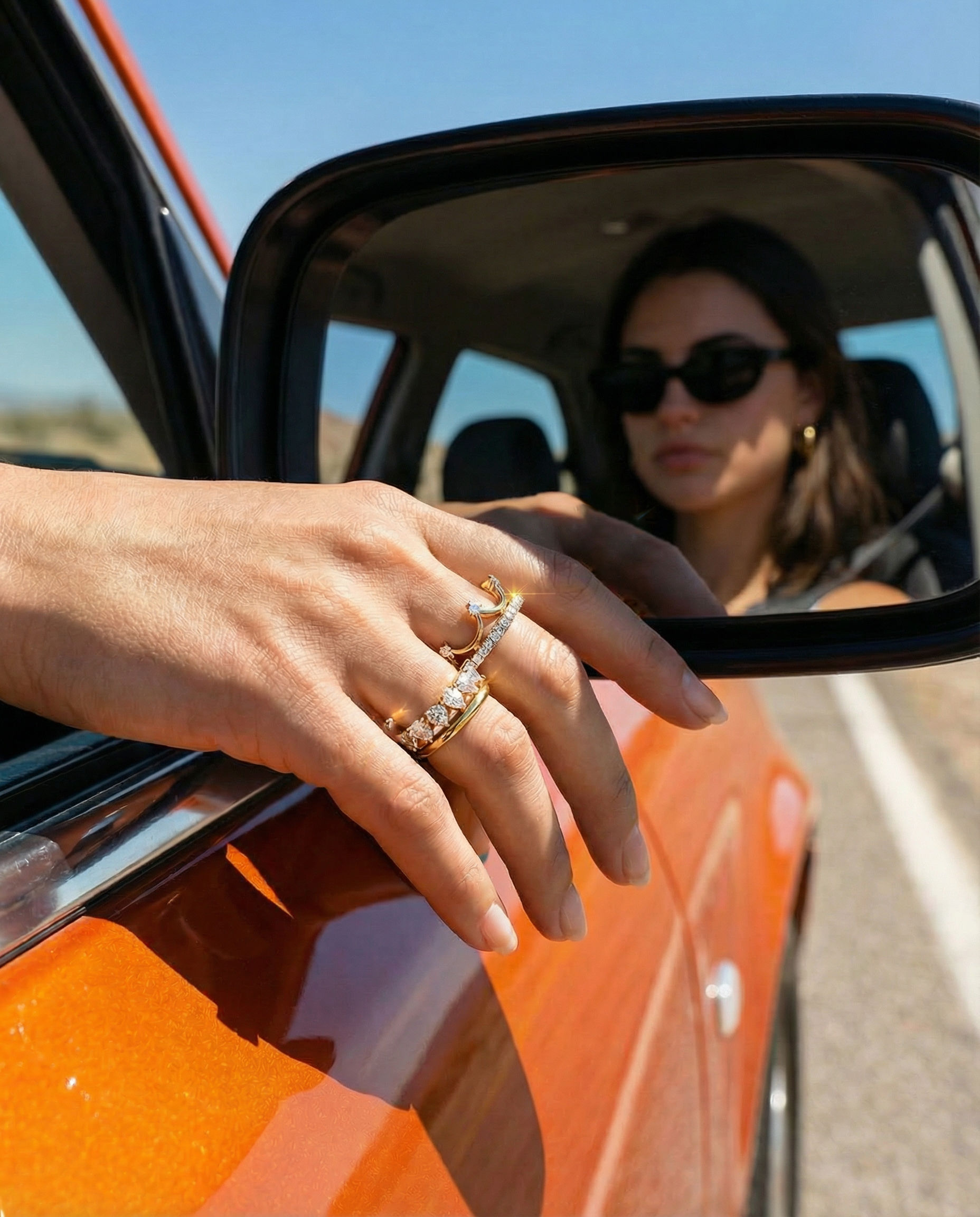
Lab grown diamond rings are moving beyond the classic solitaire. Discover six modern styles that feel fashion-first, personal and made for everyday wear.
Not every diamond ring needs to look like an engagement ring. The most interesting lab grown diamond rings right now are often the ones that borrow from fashion jewellery: chunky bands, unexpected diamond placement, sculptural shapes and rings designed to be worn on whichever finger you choose.
The classic solitaire isn't going anywhere. But it no longer owns the entire conversation around diamond rings.
You can wear diamonds on your index finger with a stack of gold bands. You can turn an emerald cut sideways. You can choose a chunky signet with a tiny diamond instead of a large centre stone. You can even build a whole hand of rings where no single piece looks like it belongs in a proposal box.
The mood is less “Will you marry me?” and more “I really like this ring.”
1. The chunky diamond band
Chunky diamond bands are a modern way to wear diamonds because the substantial silhouette makes the ring feel like a fashion piece rather than a traditional engagement ring.
The shift towards chunkier jewellery has made wider bands particularly interesting.
Instead of a slim gold band carrying one large diamond, look for a heavier silhouette with diamonds integrated into the design. The stones might run across the top, sit in a channel or appear in a more graphic arrangement.
The appeal is that the ring itself has presence.
You don't need to build the entire design around one centre stone.
Wear it alone on your index finger for a cleaner look, or pair it with slimmer bands for a more collected stack. The contrast between widths is what makes the combination feel intentional.
And if you're already wearing chunky gold hoops or a substantial watch, a wider diamond band fits right into that jewellery wardrobe.
2. The east-west diamond ring
An east-west setting places an elongated diamond horizontally across the finger, giving familiar shapes such as oval and emerald cuts a distinctly modern look.
This is one of the easiest ways to make a diamond feel less traditional without doing anything complicated.
Take an oval, emerald, marquise or elongated cushion cut and rotate it 90 degrees.
Suddenly, the same diamond has a completely different personality.
The east-west trend works particularly well with minimal bands because the horizontal stone becomes the design feature. It also looks great stacked with thin gold rings, creating a mix of proportions rather than a perfectly coordinated set.
If you've always liked elongated diamonds but don't want the classic vertical engagement-ring silhouette, this is a very good place to look.
3. The diamond signet
Diamond signet rings combine the bold proportions of traditional signet jewellery with diamond detailing, making them feel more like personal style pieces than engagement rings.
Signet-inspired jewellery has become increasingly relevant as jewellery moves towards more individual, less traditionally feminine silhouettes.
The diamond doesn't have to sit in the centre like a solitaire. It can be set into the face of the ring, paired with an engraving or used as a small detail against a larger gold surface.
That balance is what makes the style interesting.
You get the weight and attitude of a signet without losing the light-catching quality of a diamond.
Wear it on your index finger, middle finger or pinky. The same ring can look completely different depending on where it sits.
4. The sculptural diamond ring
Sculptural rings make the shape of the metal as important as the diamonds, creating designs that feel closer to contemporary jewellery than traditional engagement rings.
This is where jewellery starts behaving a little more like design.
Instead of placing a diamond neatly on top of a band, sculptural rings incorporate stones into curves, waves, open spaces and unexpected forms.
You might see a diamond tucked between two sections of gold. Or a band that twists around the finger. Or an irregular silhouette where the stone feels almost incidental to the overall shape.
These rings work particularly well if your wardrobe already has strong shapes: oversized tailoring, architectural bags, statement shoes or bold sunglasses.
You don't need your jewellery to match those pieces.
It just needs to have the same confidence.
5. The cluster ring, but make it modern
Modern cluster rings use several smaller diamonds as one visual composition instead of relying on a single centre stone.
The traditional cluster ring has a vintage association, but today's versions can look surprisingly fresh.
Think irregular clusters rather than perfectly symmetrical flower shapes. Different diamond cuts sitting together. Small stones arranged across a sculptural gold surface.
The beauty of a cluster is that your eye doesn't immediately land on one obvious centre diamond.
Instead, you notice the whole shape.
That makes it especially good for anyone who wants plenty of sparkle without the visual language of a traditional engagement ring.
And because the diamonds are usually smaller, the design can be worn more freely across different fingers and combined with other jewellery.
6. The little diamond ring that joins your stack
A small diamond ring becomes a contemporary everyday piece when it is designed to sit alongside other rings rather than function as a standalone centrepiece.
This is perhaps the most wearable approach of all.
A slim gold band with a few diamonds. A tiny bezel-set stone. A delicate curved band. Something that looks good on its own but becomes more interesting when you add two or three other rings.
The current approach to ring stacking is less about making everything match and more about mixing widths, textures and shapes.
Try a diamond band beside a plain gold ring. Add a signet on the next finger. Leave some fingers bare.
You don't need a perfectly assembled stack.
A little imbalance is what makes it look like your hand rather than a jewellery-store display.
Why are diamond rings so often associated with engagement?
Diamond rings are associated with engagement because the solitaire became a powerful cultural symbol of marriage, not because diamonds inherently represent proposals.
For decades, the most recognisable engagement-ring formula has been remarkably consistent: one prominent diamond, a slim band and a setting that places the stone at the centre of attention.
That silhouette became so familiar that the shape of the ring can communicate “engagement” before anyone even notices the diamond itself.
Change the design and that association weakens.
A horizontal emerald cut doesn't immediately read like a classic engagement ring. Neither does a chunky signet, a diamond band or a sculptural ring worn on the index finger.
The diamond hasn't changed.
The visual language has.
How to make lab grown diamond rings feel more fashion-forward
The easiest way to make a diamond ring feel fashion-led is to play with scale, placement, proportions and stacking rather than choosing a traditional solitaire silhouette.
Start with your finger placement.
Index and middle fingers give chunkier rings more room to breathe. A pinky ring creates a completely different mood. Your ring finger isn't the only destination for diamonds.
Then play with proportion.
Pair a substantial ring with delicate bands. Put a tiny diamond beside a larger gold shape. Combine a horizontal stone with a vertical stack.
Mixed metals can work too. Yellow gold beside white gold creates enough contrast to make a stack feel collected rather than overly coordinated.
The same principle applies to diamond shapes. A round diamond beside an emerald or pear cut creates visual variation without needing a complicated design.
Jewellery doesn't have to match perfectly.
It just has to make sense together.
Why lab grown diamonds work particularly well for this shift
Lab grown diamonds make it easier to explore diamond jewellery as everyday personal style because you're choosing a real diamond without being limited to the traditional engagement-ring format.
Lab grown diamonds are real diamonds, chemically and visually identical to mined diamonds. They're created in a controlled environment rather than extracted from the earth.
That distinction matters here because the conversation isn't only about engagement rings anymore.
A diamond can be part of your everyday jewellery wardrobe.
It can sit on your index finger while you're wearing denim and a white shirt. It can become part of a stack you build over time. It can mark a promotion, a birthday or absolutely nothing at all.
At Ethera, that's where lab grown diamond jewellery becomes particularly interesting. The focus can shift from “What occasion is this for?” to the much more useful question: “Would I actually wear this?”
If the answer is yes, you're already onto something.
The new diamond ring doesn't need an occasion attached to it
There's something refreshing about taking the occasion out of the equation.
You don't need to wait for an engagement to buy a diamond ring. You don't need to put it on your fourth finger. And you certainly don't need to choose the most recognisable silhouette in the jewellery cabinet.
Choose the chunky band because you like how it changes the proportions of your hand.
Choose the east-west emerald because you can't stop looking at the shape.
Choose the signet because it looks good with everything you own.
Or choose the tiny diamond band because you know you'll wear it every single day.
That's where diamond jewellery starts feeling less like a symbol you've inherited and more like a style decision you've made yourself.
And honestly, that feels much more current.
FAQs
What lab grown diamond rings don't look like engagement rings?
Chunky diamond bands, east-west rings, signet rings, sculptural designs, modern cluster rings and stackable diamond bands are all good options. They move away from the classic centre-stone-and-slim-band silhouette, so the diamond feels like part of your personal jewellery style rather than an obvious engagement symbol.
Can I wear a lab grown diamond ring on my index finger?
Yes, an index finger is a great place for a lab grown diamond ring, particularly if the design is wider or more sculptural. Chunky bands, signets and east-west settings can look especially strong here. Wearing a diamond away from the traditional ring finger also immediately gives the piece a more fashion-led feel.
What is an east-west diamond ring?
An east-west diamond ring has an elongated stone positioned horizontally across the finger rather than vertically. Oval, emerald, marquise and elongated cushion diamonds can all be set this way. The unusual orientation changes the silhouette significantly and makes the ring feel more contemporary than a traditional engagement-ring setting.
Are diamond signet rings trending?
Yes, diamond signet rings fit the wider shift towards bolder, more personal jewellery. Their substantial gold shapes make them feel different from traditional engagement rings, while small diamonds add light and detail. They also work particularly well on index, middle or pinky fingers as part of a modern ring stack.
How do you stack lab grown diamond rings?
Start by mixing different widths rather than choosing several identical bands. Pair a diamond ring with plain gold, vary the heights and consider mixing shapes or metals. You don't need every ring to match. Leaving some space between pieces can also make the stack feel more relaxed and contemporary.
Can women buy lab grown diamond rings for themselves?
Absolutely. A lab grown diamond ring can be a personal purchase rather than an engagement or relationship symbol. You can choose one to mark a career milestone, birthday, personal achievement or simply because you like the design. The reason for buying a diamond doesn't have to come from someone else.
Are lab grown diamond rings real diamonds?
Yes. Lab grown diamonds are real diamonds with the same chemical composition and crystal structure as mined diamonds. They're created in a controlled environment rather than extracted from the earth. Their appearance depends on factors such as cut, colour, clarity, carat and setting, rather than whether they're lab grown or mined.