
The 3-Ring Stack Formula That Works on Literally Every Hand, and Costs Less Than One Designer Piece
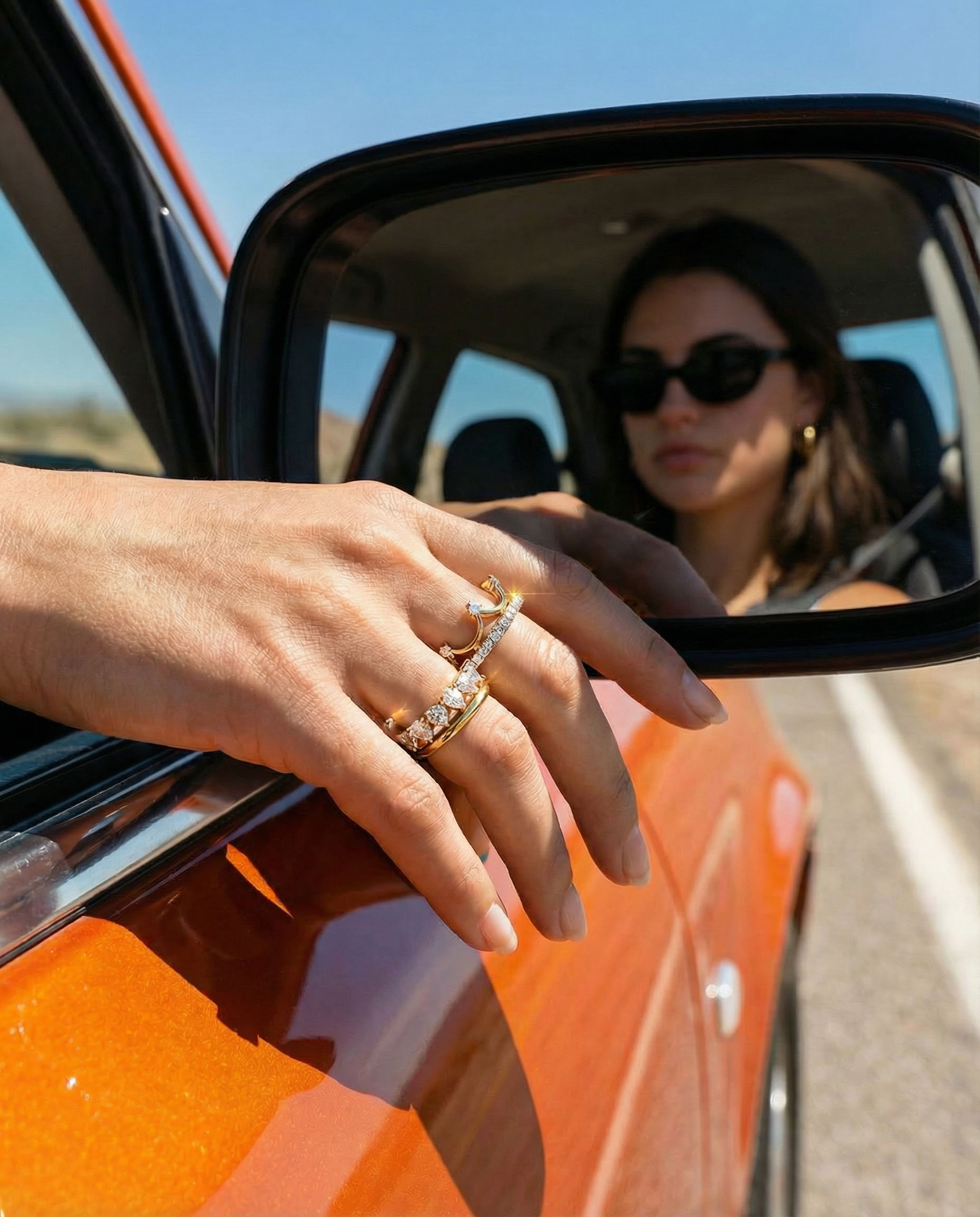
The 3-ring stack formula is simple, flattering, and endlessly versatile. Here's how to build a diamond ring stack you'll wear daily.
Most ring stacks fail for one simple reason: too many statement pieces competing for attention.
The best ring stacks aren't built around more rings. They're built around balance. That's why there's one formula that consistently works regardless of finger length, hand shape, personal style, or budget: one focal ring, one supporting ring, and one texture ring.
It's simple enough that anyone can recreate it. More importantly, it creates the layered look people love without requiring a collection worth lakhs. In many cases, a thoughtfully chosen three-ring stack can cost less than a single designer ring while looking far more personal.
The Secret Is Contrast, Not Matching
The most successful ring stacks create visual interest through contrast.
Many people assume stacking means buying rings that look nearly identical. The result is often a collection that blends together and loses impact.
The opposite approach tends to work better. A stack becomes interesting when each ring serves a different purpose.
One ring attracts attention. One adds structure. One introduces texture or sparkle. Together, they create a layered look that feels intentional rather than accidental.
That's the entire formula.
Ring One: The Focal Ring
The focal ring is the piece your eye notices first.
This is usually the largest or most distinctive ring in the stack. It doesn't need to be dramatic. It simply needs to provide a visual anchor.
A solitaire diamond ring works beautifully here. So does a three stone ring, an oval cut ring, a cushion cut diamond ring, or a pear cut design.
The key is choosing a ring with enough presence to establish the direction of the stack.
Think of it as the headline.
Everything else exists to support it.
Ring Two: The Supporting Ring
The supporting ring creates balance around the focal piece.
This ring should be quieter than the centrepiece but still contribute to the overall composition. Diamond bands, pavé rings, and slim eternity bands often work particularly well.
If your focal ring features a larger centre stone, the supporting ring can introduce sparkle without adding additional visual weight.
This creates depth while maintaining proportion.
Without this middle layer, stacks often feel unfinished.
Ring Three: The Texture Ring
The texture ring adds character.
This is where you can introduce details that make the stack feel uniquely yours. Twisted bands, beaded textures, geometric patterns, or subtle metal contrasts all work well.
Interestingly, this ring is often the smallest piece in the stack, yet it can have the biggest impact on personality.
It's the difference between a stack that looks beautiful and one that feels memorable.
Why This Formula Works on Every Hand
The three-ring stack formula works because it creates vertical balance rather than horizontal bulk.
Many people worry that ring stacking only suits long fingers or slender hands. In reality, proportion matters far more than hand shape.
A focal ring creates a centre point. A supporting ring distributes visual weight. A texture ring prevents the stack from appearing flat.
The eye naturally follows the composition rather than focusing on finger length or width.
That's why this formula remains effective across different ring sizes, hand shapes, and personal styles.
The Best Diamond Shapes for Ring Stacking
Certain diamond cut shapes are particularly effective in stacks.
Oval cut diamonds create an elongated appearance that works beautifully in layered combinations. Cushion cuts offer softer edges and a slightly vintage character. Pear cuts introduce asymmetry that immediately catches attention.
Round brilliant cut diamonds remain popular because they pair effortlessly with almost any supporting band.
Here's a quick comparison:
Diamond Shape | Stack Personality |
Classic and versatile | |
Elegant and elongating | |
Soft and romantic | |
Distinctive and modern | |
Dramatic and lengthening | |
Clean and architectural |
The best choice depends less on trends and more on which style feels most like you.
Why Three Rings Often Look Better Than Five
Adding more rings doesn't automatically improve a stack.
In fact, many of the most stylish ring stacks contain only three elements. Once you move beyond that, maintaining balance becomes significantly more difficult.
Too many rings can make individual designs disappear. They begin competing rather than complementing each other.
Three rings provide enough variety to feel layered while preserving the identity of each piece.
That's why the formula works so consistently.
It delivers visual complexity without visual clutter.
Lab Grown Diamonds Make Ring Stacking More Accessible
Lab grown diamonds have changed the economics of building a jewellery collection.
A lab grown diamond is a real diamond that is chemically, physically, and visually identical to a mined diamond. The difference is that it's created in a controlled environment rather than extracted from the earth.
For ring stacking, this matters because you're often buying multiple pieces rather than a single statement ring.
Instead of allocating an entire budget to one designer ring, many women are choosing several complementary lab grown diamond rings that offer greater styling flexibility.
The result is a collection rather than a single purchase.
Mixing Metals Is No Longer a Styling Mistake
One of the oldest jewellery rules has quietly disappeared.
For years, women were told to choose either yellow gold or white gold and stick to it. Modern styling has moved well beyond that restriction.
A white gold diamond ring paired with a yellow gold texture band can create dimension and contrast that a perfectly matched stack sometimes lacks.
The trick is consistency elsewhere. If you're mixing metals, maintain harmony through similar proportions or complementary designs.
Done well, mixed-metal stacks feel deliberate rather than mismatched.
Building a Ring Stack Over Time Makes More Sense
The best ring stacks are rarely purchased all at once.
Most women discover their favourite combinations gradually. A solitaire ring purchased today may later be paired with a diamond band. Months later, a textured ring completes the stack.
That evolution often produces more interesting results because every addition has a purpose.
The stack becomes a reflection of personal style rather than a pre-packaged set.
There's also something satisfying about building a collection piece by piece. Each ring carries its own story while contributing to the larger picture.
The Formula Is Simple, but the Possibilities Aren't
The beauty of the three-ring stack formula is that it gives you structure without limiting creativity.
One focal ring. One supporting ring. One texture ring.That's it.
Within those three roles, there are hundreds of possible combinations involving different diamond shapes, metal colours, settings, and proportions. The formula works because it creates balance first and individuality second.
Whether you're starting with a solitaire, experimenting with a three stone design, or building a collection of lab grown diamond rings, the goal isn't perfection. It's creating a stack you'll genuinely want to wear every day.
That's usually far more valuable than owning a single designer piece that rarely leaves the jewellery box.
Frequently Asked Questions
What is the best ring stack formula?
The most versatile ring stack formula consists of one focal ring, one supporting ring, and one texture ring. This combination creates visual balance, works across different hand shapes, and allows each ring to contribute something unique to the overall look.
How many rings should you wear in a ring stack?
Three rings are often considered the ideal number for a balanced stack. They provide enough layering to create interest without overwhelming the hand or making individual ring designs difficult to distinguish.
What diamond shape works best for stacking rings?
Oval cuts, round brilliant cut diamonds, cushion cuts, and pear cuts are among the most popular choices for stacking. Each shape offers a different aesthetic, but all pair well with supporting bands and textured rings.
Can you mix different ring setting types in a stack?
Yes, mixing ring setting types often creates a more interesting stack. Combining a solitaire with a pavé band or a three stone ring with a textured band can add depth and character without appearing mismatched.
Are lab grown diamond rings good for stacking?
Yes, lab grown diamond rings are particularly well suited to stacking. Because lab grown diamonds are real diamonds, they offer the same beauty and durability while making it easier to build a collection of complementary pieces.
Can ring stacks suit every hand shape?
Yes, ring stacks can work on virtually every hand shape when proportions are balanced correctly. The three-ring formula is especially effective because it creates vertical visual flow rather than adding unnecessary width or bulk.
Is it cheaper to build a ring stack than buy one designer ring?
In many cases, yes. A thoughtfully curated stack of lab grown diamond rings can cost less than a single designer statement piece while offering significantly more versatility and styling options.