
The lab grown diamond price guide — what moves the number up or down
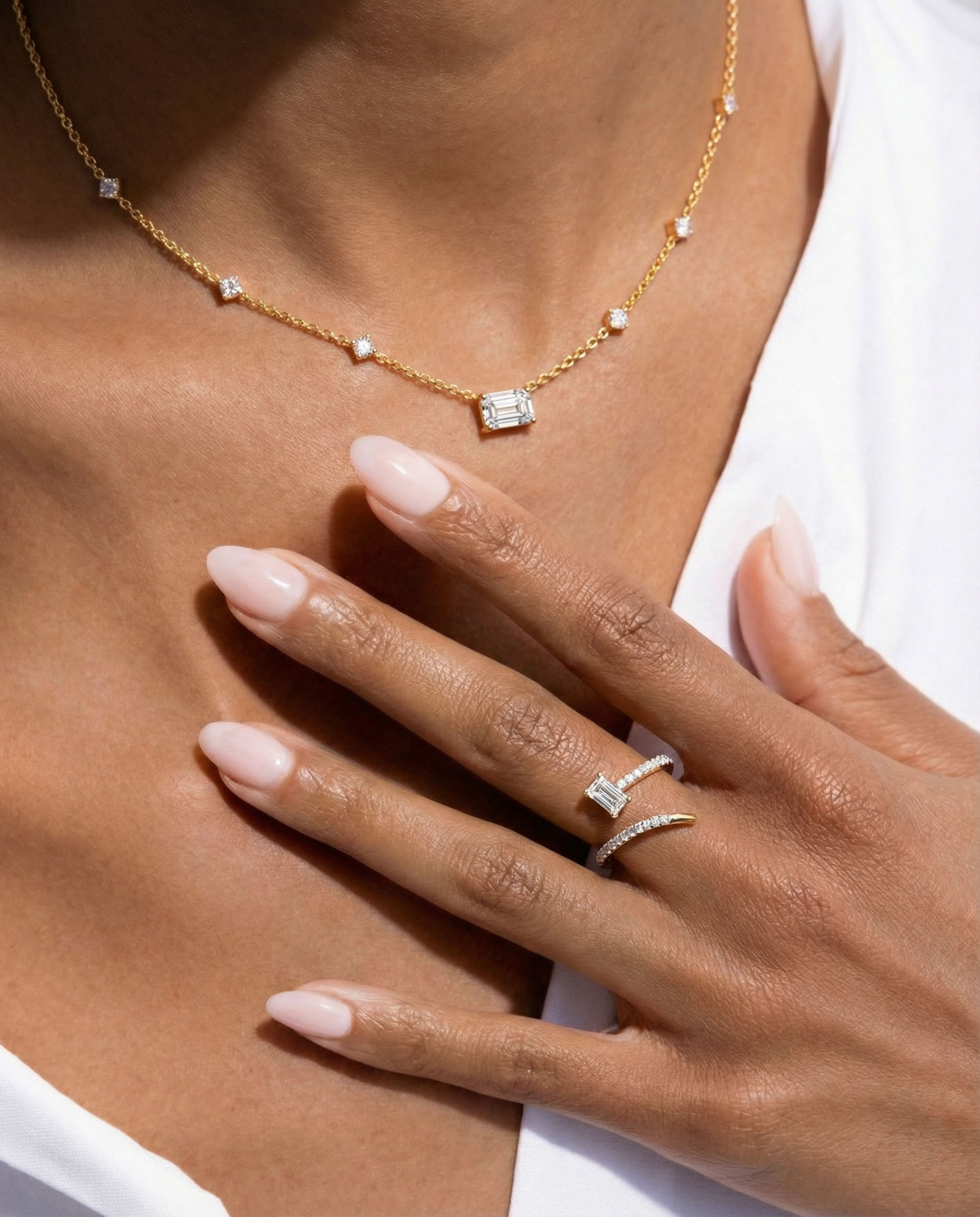
Understand lab grown diamond price with Ethera and see how carat, cut, colour, clarity, shape, gold and certification affect your final jewellery bill.
A lab grown diamond price is determined mainly by the diamond’s carat weight, cut, colour, clarity, shape and certification. Once it becomes jewellery, the gold purity, gold weight, setting, craftsmanship and taxes also enter the calculation.
That explains why two rings that both contain a one-carat diamond can have noticeably different price tags. “One carat” tells you only how much the diamond weighs. It doesn’t tell you how well it reflects light, whether it looks colourless, how visible its inclusions are or how much gold is holding it in place.
The useful question, then, isn’t simply, “How much does a lab grown diamond cost?” It’s, “What am I paying more for, and will I actually notice it?”
What is included in a lab grown diamond price?
The price of lab grown diamond jewellery usually combines the value of the diamond, the gold, the craftsmanship, the certification and the applicable taxes.
A product page may show you one final figure, but several smaller calculations are sitting underneath it.
Price component | What you’re paying for |
Diamond | Carat, cut, colour, clarity, shape and grading |
Gold | Purity, weight and the prevailing gold rate |
Making charges | Design, setting, polishing, finishing and assembly |
Certification | Independent grading and identification |
Taxes | GST and other applicable charges |
Design complexity | The number of stones, setting style and production work |
This is why comparing jewellery only by total carat weight can be misleading. A minimalist solitaire and a detailed pavé ring may contain a similar amount of diamond weight, yet require very different amounts of gold and bench work.
The price can also change when you select another gold purity, ring size or diamond specification on the same design.
Why carat weight changes the number so quickly
Carat weight measures a diamond’s weight, not its visible diameter or overall quality.
One carat equals 200 milligrams. The price doesn’t rise in a perfectly straight line as carat weight increases because larger high-quality diamonds are harder to produce consistently. A two-carat stone will therefore usually cost more than twice as much as a comparable one-carat stone.
Certain weights also attract more demand because they sound significant. One carat, one-and-a-half carats and two carats are common psychological milestones. A diamond weighing slightly below one of these points may look almost identical once set, while costing less.
That makes measurements worth checking alongside carat weight. Two diamonds of the same weight can face up differently depending on their shape, depth and proportions. A well-proportioned oval may appear larger from the top than a deeper stone that carries more of its weight below the setting.
You’re buying what you see, not just the decimal on the report.
How cut affects beauty and cost
Cut describes how effectively a polished diamond’s facets handle light, and it has a major effect on brightness, fire and sparkle.
It’s easy to confuse cut with shape. Shape is the outline, such as round, oval or emerald. Cut quality refers to the proportions, symmetry and polish that determine how light travels through the diamond.
A well-cut diamond can appear brighter and more lively than a heavier diamond with weak proportions. That’s why compromising heavily on cut to reach a larger carat weight can be a false saving. You may get more weight but less of the visual effect you wanted.
For round brilliant diamonds, grading laboratories can assign an overall cut grade. Fancy shapes such as ovals, pears and cushions require a closer look at their proportions, symmetry and light performance because their visual character varies more widely. IGI reports also document polish and symmetry and assess the craftsmanship of lab grown diamonds.
When you’re choosing where to spend, protect the cut first. It’s the quality you’ll notice every time the diamond moves.
How colour and clarity affect the price
Colour and clarity influence rarity and grading, but the most expensive grade isn’t automatically the best choice for your jewellery.
The standard colour scale begins at D, which is colourless, and continues towards Z as traces of yellow or brown become more noticeable. Differences between neighbouring grades can be subtle, especially once a diamond is mounted and viewed without comparison stones.
The setting changes what your eye sees. A near-colourless diamond can look beautifully white in yellow or rose gold because the warmer metal creates a softer visual contrast. White gold settings may make differences in colour easier to notice, particularly in larger stones or open-sided designs.
Clarity refers to internal characteristics called inclusions and surface characteristics called blemishes. Diamonds are examined under 10× magnification, even though many of these features can’t be seen without magnification.
This creates one of the easiest opportunities to spend more intelligently. An eye-clean diamond has no distracting inclusions visible during normal wear. Paying for an extremely high clarity grade may add significantly to the bill without creating a difference you can see.
The sensible balance is usually a diamond that looks clean and bright to your eye, not one that wins a grading-chart competition nobody can see from across the table.
Does diamond shape change the price?
Diamond shape can change both the price and the apparent size of a lab grown diamond.
Round brilliant diamonds often require more cutting precision and can produce more rough-material loss during manufacturing. Fancy shapes may use the original rough more efficiently, although their prices still vary according to demand, proportions and availability.
Shape also changes how large the diamond appears when viewed from above.
Diamond shape | What you may notice visually |
Balanced sparkle and a symmetrical outline | |
An elongated look that can appear larger for its weight | |
Length, movement and a distinctive pointed end | |
Broad flashes and a clear, architectural appearance | |
A softer outline with rounded corners | |
A sharp square shape with brilliant-style sparkle |
There isn’t one shape that always gives the best value. An oval can offer more visible spread, while an emerald cut may make clarity more important because its broad step facets reveal the interior of the stone more easily.
Choose the shape you’d still like after the trend cycle moves on. A small saving is irrelevant if you keep wishing you’d bought the silhouette you actually loved.
Why certification matters when comparing prices
An independent grading report identifies a diamond’s origin and records the quality characteristics used to evaluate it.
Lab grown diamonds are real diamonds produced in a controlled environment rather than extracted from the earth. They have the same optical, chemical and physical properties as mined diamonds and are evaluated using the same 4Cs: cut, colour, clarity and carat weight.
A report from a recognised grading laboratory such as IGI helps you confirm that the description used by the seller matches an independently assessed stone. An IGI report may include the diamond’s laboratory-grown origin, measurements, shape, carat weight, colour, clarity, polish, symmetry and report number. That number can also be checked through the laboratory’s verification system.
Certification doesn’t make one diamond more beautiful than another. It makes the comparison more transparent.
Without a report, two stones described as “premium quality” could mean almost anything. With one, you can compare actual specifications rather than adjectives wearing expensive perfume.
How gold purity and gold weight change the final bill
The metal can form a substantial part of the jewellery price, particularly in heavier rings, bangles, necklaces and statement designs.
Gold purity tells you how much pure gold is present in the alloy. Common options include 18KT, 14KT and 9KT gold. The remaining proportion contains other metals that give the jewellery strength, colour and wearability.
A higher-karat piece contains a greater proportion of pure gold, so it will generally cost more when the design and weight remain comparable. A lower-karat setting may reduce the overall price while offering added hardness for jewellery worn regularly.
Gold weight matters just as much as purity. A broad band, thick shank or intricate gallery will use more metal than a slim design. Even two rings with the same diamond can therefore have different final prices.
In India, BIS hallmarking records and verifies the fineness of precious-metal jewellery. A hallmark gives you third-party assurance that the stated gold purity matches what you’re paying for.
At Ethera, checking the diamond details alongside the gold purity and product weight gives you a clearer picture of where the price comes from.
Why the setting and design affect the cost
A jewellery setting changes the price because every additional stone, prong, surface and finishing step requires material and skilled work.
A classic solitaire may appear simple, but the centre stone must still be aligned, secured and finished carefully. A halo ring adds several smaller diamonds and multiple settings. Pavé designs require tiny stones to be placed closely and evenly, while an intricate statement ring may involve several components assembled by hand.
The number of diamonds also affects total carat weight. “Total carat weight” means the combined weight of every diamond in the piece. It isn’t the same as the weight of the centre stone.
For example, a ring described as one carat total weight could contain a 0.70-carat centre diamond and 0.30 carats of smaller diamonds. Another one-carat ring could feature a single one-carat solitaire. They won’t look or cost the same.
Customisation may add to the price when it involves a different stone size, an unusual setting, engraving, additional design development or a fresh mould. It can also help you allocate your budget more deliberately. You can simplify the shank, change the metal purity or adjust the supporting stones while keeping the feature you care about most.
What does a lab grown diamond cost in India?
The cost of lab grown diamond jewellery in India can range from accessible everyday pieces to several lakhs for large solitaires and elaborate designs.
There isn’t a reliable universal “price per carat” for finished jewellery because the 4Cs, shape, certification, gold and making charges all change the figure. Loose diamonds and finished jewellery must also be compared separately.
Current Ethera listings illustrate that spread. Delicate rings can begin around the lower five-figure range, while larger solitaire designs can sit much higher depending on the selected specifications. Prices can change with product configuration, promotions and gold rates, so the amount shown when you purchase is the figure that matters.
A broad budget guide looks like this:
What you’re shopping for | What usually drives the budget |
Smaller total carat weight, lighter gold and simple setting | |
Individual stone size, matched pair quality and gold weight | |
Centre-stone carat, shape, grade and setting | |
Total diamond count, design work and metal weight | |
Repeated matched diamonds, total carat weight and craftsmanship |
Treat these as categories, not fixed price bands. The quickest way to get an accurate comparison is to keep the jewellery type, centre-stone weight, diamond grades and gold purity consistent.
How to get better value without making the diamond look cheaper
Better value comes from paying for visible beauty rather than invisible upgrades.
Start with cut. A bright, well-proportioned diamond can create more impact than a larger stone that looks dull. Then look for a colour grade that appears white in your chosen metal and a clarity grade that looks clean without magnification.
You can also consider a carat weight just below a popular milestone, compare measurements rather than weight alone and explore shapes with a larger face-up appearance.
A practical priority order is:
Choose the shape you genuinely like.
Protect the diamond’s cut and overall light performance.
Find an eye-clean clarity grade.
Select a colour that works with the metal.
Adjust carat weight, gold purity or design detail to reach the budget.
Don’t reduce every specification at once. Decide what creates the emotional pull of the piece and protect that. For a solitaire, it may be the centre stone. For an everyday ring, it may be comfort. For a statement design, the outline may matter more than an unusually high clarity grade.
Ethera’s lab grown diamond collection lets you compare solitaires, everyday designs and more detailed pieces without treating every jewellery purchase like a once-in-a-lifetime event.
The number should make sense before it impresses you
The right diamond isn’t the one with the longest specification sheet. It’s the one where the features you can see, the quality you can verify and the amount you’re spending feel properly aligned.
Ask what changed when the price moved. Was it a larger centre stone? Better cut? More gold? A detailed setting? Or a clarity upgrade that disappears the moment you stop holding a loupe?
Once you can answer that, the price tag stops being mysterious. It becomes a set of choices, and those choices belong to you.
Frequently asked questions
What determines the lab grown diamond price in India?
The price is mainly determined by carat weight, cut, colour, clarity, shape and certification. In finished jewellery, gold purity, gold weight, design complexity, making charges and taxes are also included. This is why two lab grown diamond rings with the same carat weight can have different final prices.
How much does a one-carat lab grown diamond cost?
A one-carat lab grown diamond doesn’t have one fixed price because its cut, colour, clarity, shape and certification can differ. The finished jewellery price will also include the setting, gold and craftsmanship. Compare diamonds with matching specifications before deciding whether one one-carat option is genuinely better value.
Why does lab grown diamond jewellery have different prices on different websites?
Prices differ because brands may use different diamond grades, gold purities, metal weights, settings and making-charge structures. Some prices may also reflect temporary promotions. Check the centre-stone weight, total carat weight, grading report, gold purity and final payable amount before comparing two pieces.
Does a higher carat diamond always cost more?
A higher carat diamond will generally cost more when the other quality factors remain similar, but carat alone doesn’t determine the price. A smaller diamond with better cut, colour or clarity may cost more than a heavier lower-grade stone. Its proportions can also affect how large it looks.
Which diamond quality gives the best value for money?
A well-cut, eye-clean diamond in a near-colourless grade often offers strong visual value. You avoid paying heavily for microscopic clarity differences while preserving brightness and a clean appearance. The ideal combination still depends on the diamond’s shape, size, setting and the colour of the gold.
Does gold purity affect the price of lab grown diamond jewellery?
Yes, gold purity affects the final jewellery price because higher-karat gold contains a larger proportion of pure gold. The total gold weight also matters. A broad 14KT band can sometimes use more gold and cost more than a very light 18KT design, so check both purity and weight.
Should a lab grown diamond come with a certificate?
A significant lab grown diamond should come with an independent grading report from a recognised laboratory. The report confirms its laboratory-grown origin and records specifications such as carat, colour, clarity and measurements. It also gives you a consistent basis for comparing the diamond with other options.