
Lab grown diamond pendants under ₹30,000: what to look for and what to avoid
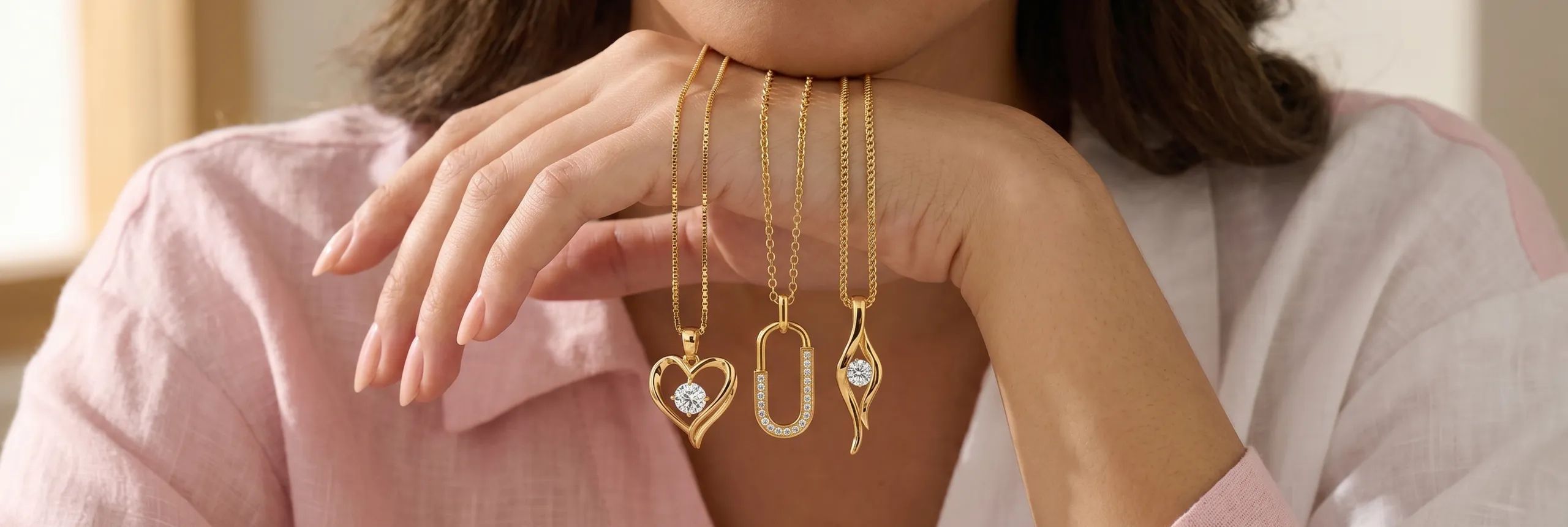
A lab grown diamond pendant under ₹30k can give you a real diamond, a solid-gold setting and a design you’ll genuinely wear beyond weddings and birthdays. The best choice isn’t automatically the pendant with the largest stone. It’s the one that balances diamond quality, gold weight, setting strength and everyday comfort without using decorative details to disguise weak construction.
That distinction matters because two pendants at the same price can be built very differently. One may spend most of the budget on a visible centre diamond. Another may use several smaller diamonds, more gold and a detailed motif. Neither approach is inherently better, but you should know what you’re paying for.
Lab grown diamonds are chemically and visually identical to mined diamonds. They’re real diamonds created in a controlled environment rather than extracted from the earth. Gemological laboratories use specialised equipment to distinguish between their different origins because ordinary visual inspection generally can’t.
Here’s how to find a pendant that looks good on the product page, sits properly on your neck and still feels like a smart purchase six months later.
What ₹30k can realistically buy in a lab grown diamond pendant
A budget of ₹30,000 can comfortably cover a small-to-medium lab grown diamond pendant set in hallmarked gold, although the exact diamond size depends on the design and whether a chain is included.
A solitaire pendant concentrates the budget into one visible stone. A cluster, floral or butterfly design spreads the same diamond weight across several smaller stones. A diamond letter pendant may use tiny pavé-set diamonds across a gold initial, while a name in diamonds necklace usually costs more because it needs customised lettering, extra gold and several stones.
This is why carat weight alone can be misleading. A pendant with a total diamond weight of 0.30 carat may contain one 0.30-carat stone, three 0.10-carat stones or dozens of tiny diamonds. Those three pieces won’t look remotely alike.
You should also check whether the displayed price includes the chain. Some listings price only the pendant, while others include a lightweight gold chain.
At this price, you’ll generally get the most visual impact from clean solitaires, geometric motifs, alphabet pendants, petite nature-inspired designs and compact clusters. A 1-2 carat diamond necklace is unlikely to fit this budget if you mean a single large diamond set in solid gold. A necklace with approximately 1.3 carats of total diamond weight may also sit considerably above it, depending on the design, gold weight and stone specifications.
Choose the pendant style before comparing carat weight
The right pendant style determines how large, bright and wearable your diamond jewellery appears more than the carat number printed on the certificate.
A single stone diamond necklace gives you the cleanest look. Because there’s only one diamond, your eye reads its complete outline immediately. Round, oval, pear and princess-cut stones work particularly well in small pendants because their shapes remain recognisable even from a slight distance.
A cluster pendant creates a larger-looking surface using several smaller stones. It can deliver more sparkle across the neckline without requiring one high-carat centre diamond. Look closely at the gaps between stones, though. Poorly arranged clusters can appear uneven or overly busy.
A diamond letter pendant makes the design personal without becoming sentimental theatre. The letter should be easy to recognise, with diamonds following its shape rather than turning it into a shapeless glitter patch. A well-made initial also needs enough gold underneath to keep the form stable.
A name in diamonds necklace is more customised and usually less flexible. You’ll need to consider the length of the name, font, gold weight, chain attachment points and whether the lettering flips while worn. Under ₹30,000, a single initial or short symbolic motif often gives you better construction than a long custom name.
Diamond butterfly necklaces offer a softer, more decorative option. The best versions use symmetry carefully, with matching wings and a balanced centre. Avoid designs where the butterfly is too light for the chain, as it may tilt, turn or refuse to sit flat.
How to assess diamond quality without overpaying
Diamond quality in a pendant should be judged by what you can actually see at neckline distance, not by chasing the highest specification in every category.
The four Cs are cut, colour, clarity and carat weight. For a pendant, cut deserves particular attention because it affects how efficiently the diamond reflects light. A lively, well-cut smaller stone can look more appealing than a larger diamond that appears dull.
Colour grades describe how colourless a diamond appears. You don’t always need the very highest colour grade for a pendant, especially when the stone is small. Near-colourless diamonds can appear bright and white once set, particularly in white gold.
Clarity measures internal and external characteristics known as inclusions and blemishes. Many inclusions aren’t visible without magnification. Paying more for an extremely high clarity grade may make little practical difference in a pendant that’s viewed from conversational distance.
Carat measures weight, not physical dimensions. Two diamonds with the same carat weight can look different in size depending on their cut proportions and shape. An oval or pear-shaped diamond may appear longer than a round diamond of similar weight, giving you more visible presence across the neckline.
For multi-stone designs, check the total carat weight and the number of diamonds. A listing that says “0.30 carat” may refer to the combined weight of every stone in the pendant, not the size of the largest diamond.
What to check | Why it matters | Warning sign |
Cut and sparkle | Affects how bright the diamond looks | A large stone that appears grey or flat |
Total versus centre carat | Shows how diamond weight is distributed | Total weight presented as if it belongs to one stone |
Colour and clarity range | Helps you compare similar products | No diamond specifications listed |
Certification | Confirms the stated diamond details | Vague claims without documentation |
Number of stones | Explains the pendant’s overall look | Many tiny stones used to inflate the carat figure |
Look closely at the gold, setting and hallmark
The gold framework matters as much as the diamonds because it keeps the pendant secure, comfortable and properly positioned.
Within a ₹30,000 budget, you may find designs in 9KT, 14KT or 18KT gold. Karat indicates the proportion of pure gold in the alloy. A lower karat uses a higher proportion of strengthening metals, which can make the piece more practical for frequent wear while reducing its gold cost.
This doesn’t mean you should choose the lightest possible setting. A pendant needs enough gold around its stone, prongs and bail to withstand regular movement. The bail is the loop through which the chain passes. It should be smooth, securely joined and large enough for the intended chain without appearing oversized.
Prong settings expose more of the diamond and can make a solitaire look bright, but every prong should sit neatly against the stone. Bezel settings wrap a slim border of metal around the diamond, creating a cleaner outline and offering more protection. For everyday wear, a well-proportioned bezel can be particularly fuss-free.
Check the back of decorative pendants too. An open back can allow light through and reduce weight, but the edges should still feel smooth. Sharp galleries, unfinished surfaces and hollow sections that dent easily are signs to pause.
For gold jewellery sold in India, look for the relevant BIS hallmark and HUID, or Hallmark Unique Identification number. The HUID is a unique six-character alphanumeric code that can be checked through the BIS Care app.
Make sure the pendant and chain work together
A diamond pendant will only sit well if its weight, attachment and chain length are compatible.
Tiny pendants can disappear on thick chains, while substantial motifs can drag down chains that are too fine. The chain should support the piece without competing with it. For most everyday pendants, a delicate but structurally sound chain gives the cleanest result.
Chain length changes the entire effect. A shorter chain keeps the pendant closer to the collarbone and works well with open necklines. A slightly longer chain gives you more room around crew-neck tops and layered outfits. Adjustable links are useful because necklines aren’t consistent, and neither is your wardrobe.
Pay attention to whether the pendant slides freely or is fixed to the chain. A free-moving pendant is easier to transfer between chains, but it may travel sideways during the day. A fixed pendant stays centred more reliably, especially in alphabet, butterfly and horizontal bar designs.
A name necklace needs two balanced attachment points to stop the lettering from flipping. A single initial may hang from one top bail, while a broader motif often sits better when connected on both sides. These tiny construction choices rarely headline the product description, yet they decide whether you enjoy wearing the piece.
What to avoid when shopping below ₹30,000
The biggest mistake is choosing a pendant for its apparent size without checking how that size has been created.
Some designs use an oversized gold halo, closely packed metal beads or wide empty outlines to make a very small diamond arrangement seem larger. That isn’t necessarily dishonest, but the product photographs should make the construction clear. Zoomed-in images can make a petite pendant appear far more substantial than it will on your neck.
Avoid buying from a listing that hides essential information. You should be able to find the gold karat, gold weight, diamond weight, stone count, colour and clarity range, chain inclusion, certification details and final price components without solving a tiny jewellery-themed detective novel.
Be cautious with extremely thin alphabet pendants. Letters have corners, joins and narrow sections that can bend if the gold is too light. The same applies to butterfly wings, floral petals and open geometric motifs. Delicacy should come from proportion, not fragility.
A “natural diamond pendant” and a lab grown diamond pendant shouldn’t be treated as interchangeable product labels. Both use real diamonds, but their origins and pricing structures differ. A trustworthy listing will state the diamond’s origin clearly rather than using vague wording.
You should also avoid paying for specifications you can’t appreciate. Ultra-high clarity may be valuable in a collector-grade stone, but it can be an unnecessary expense in a petite everyday pendant. Spend first on a pleasing design, visible sparkle, sound construction and a chain that sits comfortably.
How to choose a lab grown diamond necklace you’ll actually wear
The most wearable lab grown diamond necklace is one that fits your normal clothes, usual necklines and tolerance for jewellery maintenance.
Start with the pieces already in your wardrobe. If you mostly wear shirts, V-necks and relaxed kurtas, a simple solitaire or compact geometric pendant will slip into rotation easily. If your wardrobe leans feminine and detailed, a butterfly, floral cluster or initial may feel more natural.
Think about visual scale. Petite designs are easy to layer and rarely feel overdressed. Slightly larger pendants hold their own when worn alone. A diamond letter works as a quiet signature, while a single stone diamond necklace gives you a cleaner, more grown-up focal point.
Metal colour matters too. Yellow gold creates a warmer contrast around the diamonds. White gold makes the setting visually recede, which can make the stone arrangement appear more continuous. Rose gold adds softness but may be harder to match if most of your jewellery is yellow or white.
At Ethera, you can compare lab grown diamond pendants by design, diamond details, gold purity and final price rather than treating carat weight as the only measure of value. The useful question isn’t “Which one gives me the most diamond?” It’s “Which one still looks considered when I wear it with an ordinary Tuesday outfit?”
Is a lab grown diamond pendant under ₹30,000 worth buying?
A well-made lab grown diamond pendant below ₹30k is worth buying when you want real diamond jewellery with everyday wearability rather than maximum size at any cost.
The controlled growing process makes it possible to allocate more of your budget towards visible design and diamond presence than you might expect from traditionally priced mined-diamond jewellery. What still matters is transparency. The diamond origin, specifications, gold purity and certification should be stated clearly.
Value also depends on frequency. A pendant you wear three times a week can make more sense than a larger piece that spends most of its life in a box. Jewellery earns its place through use, not through the seriousness of the occasion you bought it for.
That’s the quiet advantage of staying around ₹30,000. You’re choosing something considered, but not so ceremonious that it waits for permission to leave the cupboard.
Frequently asked questions
Can I get a real lab grown diamond pendant under ₹30,000?
Yes, you can buy a real lab grown diamond pendant in solid gold within ₹30,000. The available diamond size will depend on the gold purity, setting, chain and design. Simple solitaires, clusters, alphabet pendants and small motifs usually offer the strongest combination of visible sparkle and sound construction. Browse Ethera’s collection here.
What diamond size can I expect in a pendant below ₹30,000?
The diamond weight can range considerably because some pendants use one centre stone while others use several smaller diamonds. You should check whether the stated carat figure is the centre-stone weight or total carat weight. A well-cut smaller stone may also look brighter and more noticeable than a poorly cut larger one.
Is a single stone diamond necklace better than a cluster pendant?
A single stone diamond necklace gives you a cleaner outline, while a cluster pendant creates a broader area of sparkle using multiple stones. Neither is universally better. Choose a solitaire for a minimal everyday look and a cluster when you want more visual texture without paying for one large centre diamond.
Can I buy a diamond letter pendant under ₹30,000?
Yes, many diamond letter pendants can fit within ₹30k, especially when the initial uses small pavé-set diamonds. Check that the letter is structurally strong, clearly shaped and made with enough gold around narrow joins. You should also confirm whether the displayed price includes the chain.
Are diamond butterfly necklaces suitable for everyday wear?
Diamond butterfly necklaces can work for everyday wear when the motif is compact, balanced and securely attached to the chain. Look for smooth edges, matching wings and a design that sits flat. Very wide or extremely lightweight butterflies may tilt or flip, which can become annoying during regular use.
Is a 1.3 carat diamond necklace available below ₹30,000?
A necklace with one 1.3-carat diamond is unlikely to fall below ₹30,000 once gold and setting costs are included. A design with 1.3 carats of total diamond weight will also usually cost more. Always check whether “1.3 carat” refers to one stone or the combined weight of many diamonds.
How do I verify the gold used in a diamond pendant?
Check the jewellery for its BIS hallmark and unique HUID code. The product details should also state the gold purity, such as 9KT, 14KT or 18KT. Hallmark verification helps confirm that the stated gold fineness matches the tested article.
Do lab grown diamond pendants look different from mined diamond pendants?
No, lab grown diamonds don’t look visibly different simply because they were grown in a controlled environment. They have essentially the same chemical, optical and physical properties as mined diamonds. Their different origins are identified through specialised gemological testing, not by casually looking at the pendant.