
Stop coordinating your jewellery with your outfit. Start doing this instead.
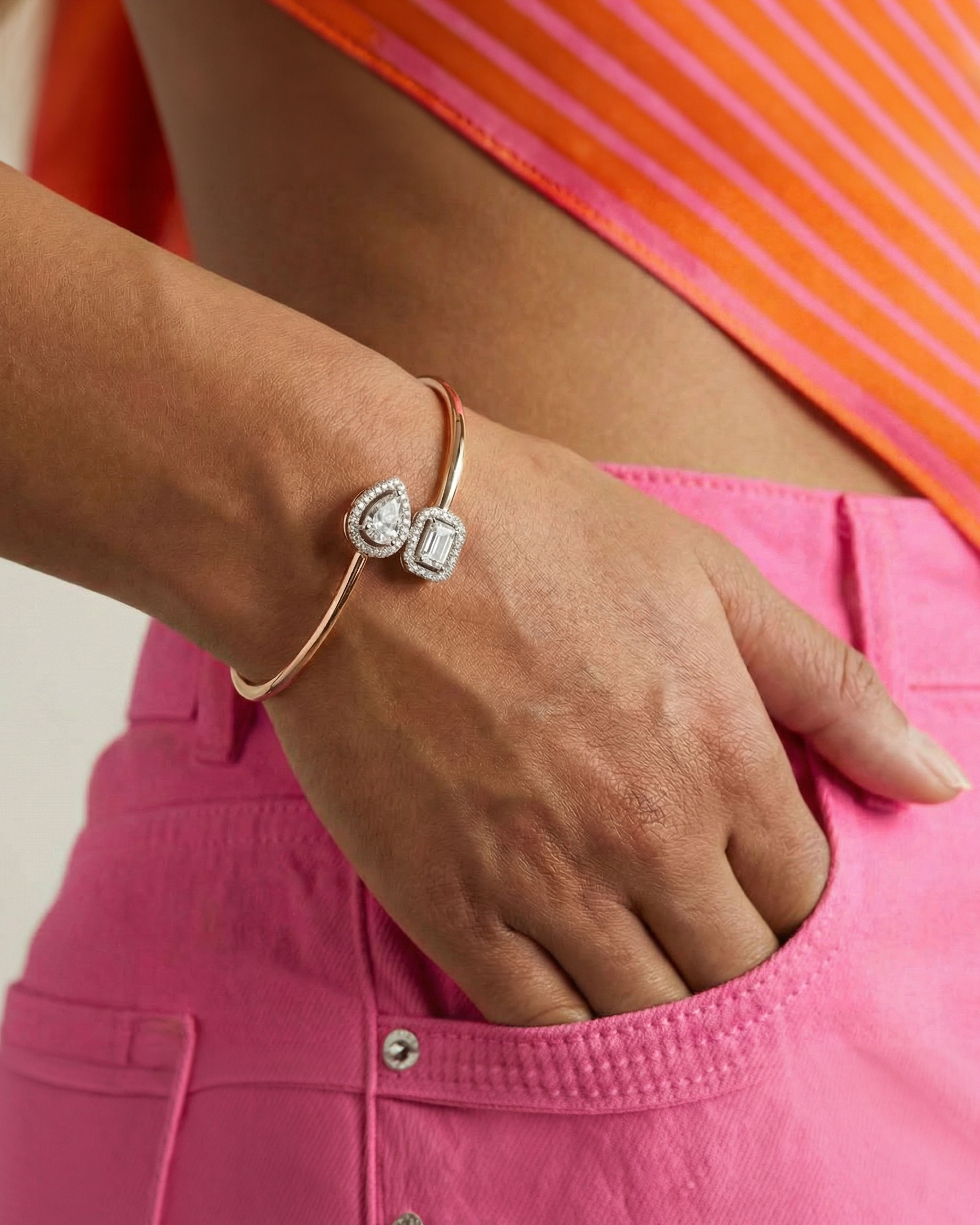
Stop coordinating your jewellery with every outfit. Ethera shows how contrast, repetition and personal style create looks that feel far more natural.
Coordinating your jewellery with every colour, neckline and fabric isn’t the secret to looking put together. The better approach is to choose jewellery around your personality, proportions and plans, then let it create a little tension with the outfit.
Matching can look polished, of course. Emerald earrings with a green saree will never cause public concern. But when every detail has been carefully paired, the result can feel less like personal style and more like a display window.
The women whose jewellery you notice rarely seem to be matching it perfectly. They repeat the same ring with wildly different outfits. They wear diamonds with oversized shirts, vintage earrings with clean tailoring and a bold cuff when the clothes are almost aggressively simple.
Their jewellery belongs to them first. The outfit comes second.
Coordinating your jewellery too carefully can flatten your style
Perfectly matched jewellery can make an outfit look complete, but it can also remove the contrast that gives personal style its character.
Think of an embroidered kurta worn with equally ornate earrings, a matching necklace and bangles that repeat the same colours. Nothing is technically wrong. Everything agrees. Perhaps a little too enthusiastically.
Now imagine that same kurta with small diamond hoops and one bold ring. The outfit feels lighter because the jewellery isn’t repeating what the clothes have already said.
Contrast creates interest. A clean solitaire can sharpen a romantic dress. A sculptural earring can wake up a plain shirt. A delicate diamond bracelet can sit beautifully beside a sporty watch because the two pieces don’t come from the same visual universe.
Matching asks, “Does this belong with the outfit?”
Personal style asks, “Does this belong on me?”
The second question is usually more useful.
Style your jewellery around the mood, not the colour
Jewellery looks more intentional when it matches the energy of an outfit rather than copying its colour palette.
Colour matching is the most obvious route, which is why it can also feel predictable. Blue stones with a blue dress, yellow gold with warm prints, white gold with cooler shades. These combinations work, but they’re only one part of styling.
Mood gives you more room.
A sharply tailored suit has a controlled, structured mood. You might continue that feeling with geometric studs, or interrupt it with soft diamond drops.
A floaty dress feels romantic and relaxed. You could echo that softness with a delicate pendant, or give it more edge with a chunky ring.
A plain cotton kurta has visual quietness. That makes it a strong backdrop for ear climbers, layered chains or a statement cuff.
Here’s a simpler way to choose:
Outfit mood | Jewellery that continues it | Jewellery that contrasts it |
Clean and tailored | Soft drops, organic shapes | |
Romantic and fluid | Fine pendants, curved hoops | Structured cuffs, sharp solitaires |
Relaxed and casual | Huggies, small charms | One bold cocktail ring |
Traditional and detailed | Classic studs, fine bangles | |
Monochrome | Sleek metal pieces | Coloured stones or sculptural designs |
Playful | Motif jewellery, layered charms |
You don’t have to choose harmony or contrast every time. The useful part is choosing deliberately instead of defaulting to colour coordination.
Repeat your favourite jewellery more often
Repeating the same jewellery across different outfits is one of the clearest ways to develop a recognisable personal style.
You probably already do this without noticing. There’s a ring you leave on for days. A pair of earrings that seems to work whenever you’re running late. A pendant that appears in half your photographs because removing it barely crosses your mind.
Those pieces are more valuable to your style than a perfectly coordinated set worn once.
Repetition creates identity. Audrey Hepburn had pearls. Princess Diana had her sapphire ring. Contemporary celebrity style often works the same way, with a recognisable combination of hoops, stacks, solitaires or signet rings appearing across red carpets and airport photographs alike.
You don’t need a signature piec
e grand enough to receive a name. You simply need jewellery that feels convincing across several versions of your wardrobe.
Wear the same diamond hoops with a blazer, a saree and a white T-shirt. Put the same oval ring beside a watch one day and a bracelet stack the next. The piece begins to look more like part of you and less like something selected for an outfit.
That’s when styling gets easier.
Choose one point of tension
A good jewellery look often contains one element that seems slightly unexpected but still feels intentional.
This could be a traditional motif worn with a minimalist dress. It could be a tennis bracelet beside a casual sweatshirt. It could be a sleek white-gold ring with warm yellow-gold hoops.
The tension gives your eye somewhere to pause.
Without it, an outfit may look neat but forgettable. With too much of it, the look becomes a committee meeting where everyone is speaking at once. One contrasting idea is usually enough.
Try one of these combinations:
A crisp white shirt with long diamond earrings
A printed saree with plain huggies
A romantic dress with a geometric ring
A blazer with playful motif studs
A black kurta with mixed-metal bracelets
Denim with a fine tennis necklace
The goal isn’t to appear rebellious through the dangerous act of wearing two metal colours. It’s simply to stop making every choice agree perfectly.
Let your face and hands decide what works
Jewellery should respond to your features and proportions before it responds to your outfit.
Earrings sit beside your face, so their length, width and movement affect how the complete look reads. Long drops create a vertical line. Round hoops add width and softness. Ear climbers draw the eye upwards. Studs keep the area clean and focused.
Necklaces interact with your neck and collarbone. A short pendant keeps the eye near your face, while a longer chain creates a vertical line through the torso. The exact neckline matters, but not because the necklace must match it. The two simply need enough space to remain visible.
Rings and bracelets should suit how you use your hands. A delicate ring may disappear if you naturally wear several bold pieces. A high-set stone may look beautiful but become annoying if you type all day or constantly reach into bags.
This is where generic jewellery rules fall apart. A styling guide might insist that round faces should avoid hoops or that certain necklines require certain chains. Your comfort and visual preference matter more than a diagram.
Try the jewellery on. Move around. Look at it from conversation distance rather than two centimetres from a mirror. Jewellery is rarely experienced as a close-up product shot in real life.
Mix metals without trying to disguise it
Mixing yellow gold, white gold and rose gold can make a jewellery look feel collected over time rather than purchased as a complete set.
The old rule said every metal had to match. Your earrings, chain, watch, ring and bag hardware were apparently expected to hold a morning conference before you left the house.
You can ignore that rule.
The easiest way to mix metals is through repetition. If you wear a yellow-gold ring and a white-gold bracelet, bring one of those colours back elsewhere. A watch, second ring or two-tone piece helps the mix look deliberate.
You can also let one metal dominate. Wear mostly yellow gold, then add one white-gold diamond ring as the contrast. The metals don’t need equal representation.
A diamond acts as a useful bridge because its colourlessness sits comfortably with different gold tones. Lab grown diamond jewellery works particularly well here because you can choose designs based on form and wearability rather than feeling locked into a single matching set.
Mixed metals often look more personal because real jewellery collections rarely arrive all at once. They grow through gifts, purchases, inherited pieces and small obsessions.
Let yours look lived in.
Stop treating a matching set as one fixed unit
A jewellery set becomes far more useful when you separate its pieces and wear them in unexpected combinations.
Matching earrings, necklaces, rings and bracelets are often bought together because the complete set looks reassuring. The design language is consistent. Nothing clashes. The box closes neatly.
The problem is that the full set can feel overly formal outside a wedding or major celebration.
Break it apart.
Wear the earrings with a plain shirt. Pair the necklace with an unembellished dress. Put the bracelet beside your everyday watch. The ring may work beautifully with pieces you already own rather than the partners it arrived with.
This is particularly useful with traditional jewellery. A pair of floral diamond earrings can feel modern when removed from the matching necklace. A detailed pendant can work over a plain knit or band-collar kurta. A dressier ring may look fresher beside a simple manicure and rolled-up sleeves.
You’re not disrespecting the set. You’re giving each piece a social life.
Build a jewellery wardrobe around roles
A useful jewellery collection contains pieces that perform different jobs rather than several pieces that solve the same outfit problem.
You don’t need six delicate pendants unless delicate pendants are truly your life’s work. A more versatile collection includes a quiet piece, a visible piece, a piece with movement and something that feels distinctly personal.
Think in roles:
Jewellery role | What it does | Examples |
The default | Works when you don’t want to think | Diamond studs, huggies, slim pendant |
The finisher | Makes a simple outfit feel considered | Tennis bracelet, stackable rings |
The main character | Carries the whole look | Long drops, sculptural earrings |
The personal piece | Adds meaning or identity | Initial ring, engraved pendant |
The contrast | Interrupts predictable styling | Mixed-metal ring, bold cuff |
The occasion bridge | Moves from work into evening | Short drops, halo studs |
Once each piece has a role, you stop choosing jewellery by colour alone. You choose it according to what the outfit needs.
Sometimes the clothes need quietness. Sometimes they need a focal point. Sometimes they need one detail that makes you feel more like yourself.
Everyday jewellery styling starts before you get dressed
Choosing jewellery first can lead to more interesting outfits because the clothes become a backdrop rather than the main event.
Start with the ring you haven’t worn enough. Choose the earrings that make you sit slightly straighter. Put on the bracelet stack you usually reserve for dinner.
Then dress around the jewellery without copying it.
A statement earring may lead you towards a clean neckline. A tennis necklace might make an oversized shirt feel surprisingly polished. A colourful motif ring could steer you towards neutral clothing so the design has space.
This reverses the usual order. Instead of treating jewellery as the final five per cent, you let it set the tone.
It also helps you wear more of what you own. Many pieces stay untouched because they’re waiting for the correct outfit to appear. When the jewellery comes first, you realise that “correct” was doing far too much administrative work.
Lab grown diamonds give you more room to develop a style
Lab grown diamonds make it easier to build a varied jewellery wardrobe because you can explore more shapes, scales and designs within your budget.
They’re real diamonds, chemically and visually identical to mined diamonds, created in a controlled environment rather than extracted from the earth. Their different origin usually means a different price, which can give you more freedom to choose based on personal style.
That might mean owning both a pair of everyday hoops and one dramatic drop rather than directing your entire budget towards a single safe piece. It may mean choosing an ear climber, fancy-cut ring or sculptural pendant because the design excites you more than the expected classic.
The material still deserves proper craftsmanship. Check certification, settings, clasps and gold hallmarks. A real diamond doesn’t rescue an uncomfortable earring or a poorly finished ring.
Ethera’s lab grown diamond jewellery is designed for repeat wear, with IGI-certified diamonds and BIS-hallmarked gold. The useful part isn’t simply having more pieces. It’s having enough range to discover what you actually return to.
The outfit doesn’t need the final vote
Your jewellery doesn’t have to disappear neatly into whatever you’re wearing.
It can interrupt. It can repeat. It can be the one polished element in a relaxed look or the one playful detail in a serious one. It can show up for weeks in a row without apologising for being familiar.
The most stylish choice usually isn’t the piece that matches best. It’s the one that feels so natural on you that the outfit simply learns to live with it.
Frequently asked questions
Should your jewellery always match your outfit?
No, your jewellery doesn’t always need to match your outfit. Choosing pieces that contrast with the clothing can create a more personal and interesting look. Focus on the outfit’s mood, your proportions and the jewellery you enjoy repeating instead of matching every colour, fabric or decorative detail.
How do you style jewellery without matching colours?
Style jewellery by responding to shape, mood and visual weight rather than colour. Pair structured jewellery with soft clothing, delicate pieces with tailoring or bold earrings with a plain neckline. The contrast should look intentional, while one repeated shape or metal can keep the overall look connected.
Is it okay to mix gold and silver-coloured jewellery?
Yes, you can mix yellow gold with white gold or silver-coloured pieces. Repeat one metal in another part of the look or let one colour dominate while the other acts as an accent. Diamonds help connect different metal tones because their colourless appearance works comfortably with each of them.
How do I choose jewellery for an outfit?
Choose jewellery according to what the outfit is missing. A detailed outfit may need simple studs, while plain clothing can carry statement earrings or a bold ring. Consider your neckline, hairstyle, routine and comfort, but don’t feel that the jewellery must repeat the outfit’s colours or motifs.
What jewellery goes with every outfit?
Diamond studs, small hoops, a slim pendant and a balanced ring work with most outfits because their shapes are simple and easy to repeat. No piece literally suits every look, so choose the designs that fit most of your wardrobe and feel comfortable enough to wear without much thought.
Can statement jewellery be worn with casual clothes?
Yes, statement jewellery often looks especially modern with casual clothing. Pair long diamond earrings with a white shirt, a bold ring with denim or a tennis necklace with a plain T-shirt. Keeping the rest of the look simple gives the jewellery space without making the outfit feel overly formal.
How can I create a signature jewellery style?
Create a signature jewellery style by repeating a few favourite pieces across different outfits. Choose a recognisable shape, metal combination or styling habit, such as hoops, stacked rings or a daily pendant. Consistency matters more than owning a large collection because repetition makes the look feel distinctly yours.
Is lab grown diamond jewellery good for everyday styling?
Yes, lab grown diamond jewellery works well for everyday styling because lab grown diamonds are real, durable diamonds with the same chemical and visual properties as mined diamonds. Choose secure, comfortable settings and designs that fit your routine. Their pricing can also make it easier to explore different styles.