
How to Measure Bangle Size at Home Accurately
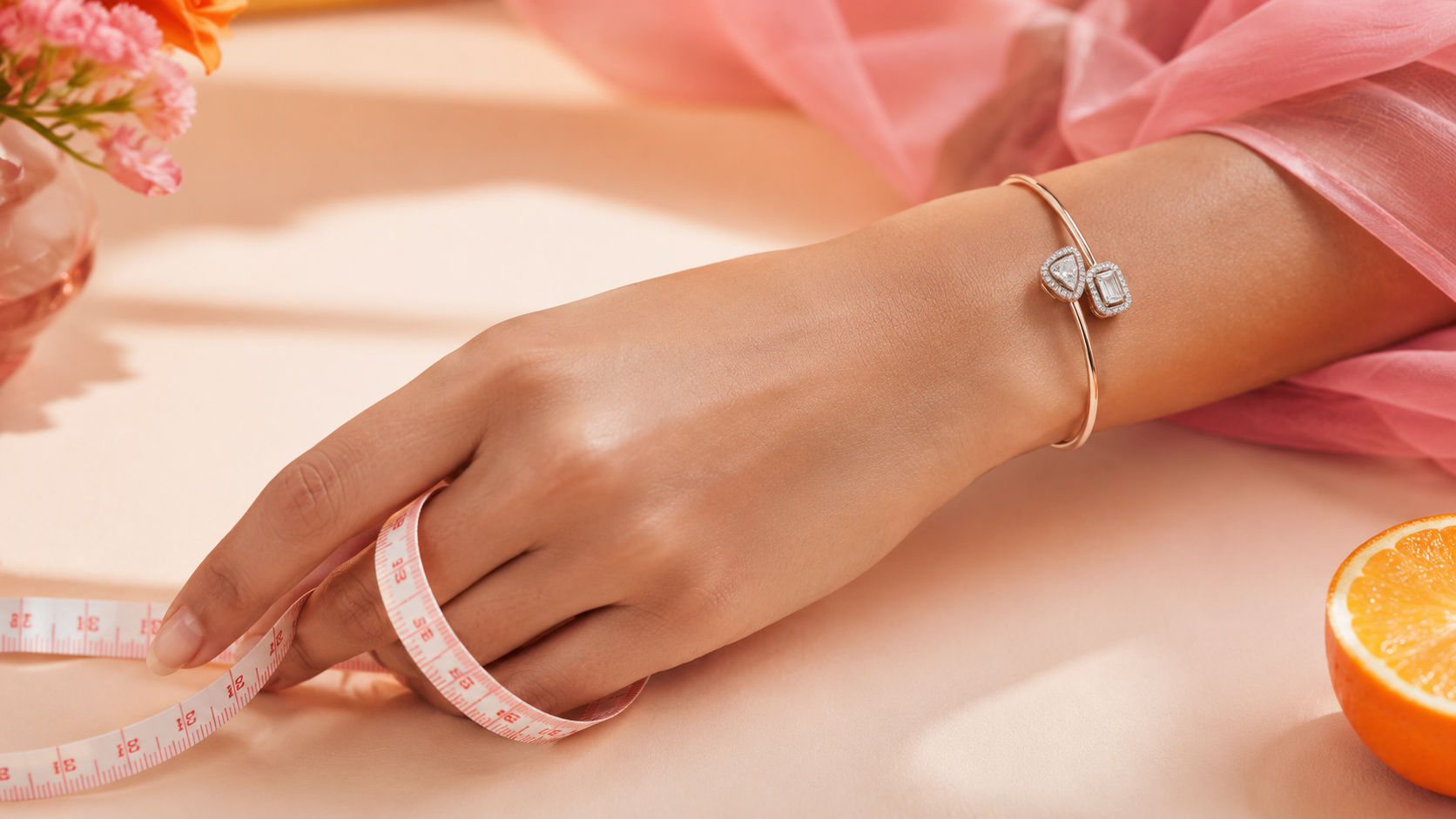
Learn how to measure bangle size at home using your hand or an existing bangle, with an Indian bangle size chart and practical fitting tips.
Bangles can finish an outfit without making a production of it. A slim diamond bangle works with office shirts, kurtas and everything you panic-pick five minutes before leaving. A stack brings more personality. Either way, the sparkle only works when the fit does.
A closed bangle that is too small will not pass comfortably over your knuckles. One that is too large may keep travelling down your hand or slip off altogether. That is why learning how to measure bangle size at home accurately is worth the few minutes it takes.
Below are two simple methods: one for when you have a well-fitting bangle nearby, and another for when you are starting from scratch.
Why Getting Your Bangle Size Right Matters
Unlike most chain bracelets, traditional closed bangles do not have a clasp or adjustable extension. They must be large enough to pass over the widest part of your hand, then sit comfortably around your wrist.
The right size should:
Slide over your hand with gentle pressure
Rest comfortably without pinching
Move naturally without feeling unstable
Stay secure when you lower or move your hand
Reduce unnecessary pressure on the bangle and its setting
Sizing matters even more for diamond bangles. Forcing a delicate or stone-set piece over the hand can place unnecessary stress on its structure.
A Quick Note on Indian Bangle Sizes
Indian bangle sizes are commonly written as 2-2, 2-4, 2-6 and 2-8. You may also see the same sizes written with a decimal point, such as 2.4 or 2.6.
That decimal is not a standard decimal measurement. A size 2-4 refers to an internal diameter of 2 inches and 4 sixteenths of an inch, or 2.25 inches. A size 2-6 measures 2 inches and 6 sixteenths, or 2.375 inches. (Ivana Jewels)
So no, bangle sizing did not decide to make maths easy for us.
How to Measure Bangle Size at Home
You can find your size in one of two ways:
Measure the inner diameter of a bangle that already fits
Measure around the widest part of your hand
The existing-bangle method is usually more reliable because it starts with a fit you already know and like. The hand method is useful when you do not own a closed bangle yet.
Method 1: Measure a Bangle That Already Fits
Have a bangle that slides on comfortably and does not threaten to escape every time you move your hand? Use that.
What You Need
A well-fitting closed bangle
A ruler marked in millimetres or centimetres
Steps
Place the bangle flat on a level surface.
Lay the ruler across its centre.
Measure from one inner edge to the opposite inner edge.
Do not include the thickness of the metal.
Compare the measurement with the chart below.
Indian Bangle Size Chart by Inner Diameter
Indian bangle size | Inner diameter in inches | Inner diameter in millimetres |
|---|---|---|
2-2 | 2.125 | 54.0 mm |
2-4 | 2.250 | 57.2 mm |
2-6 | 2.375 | 60.3 mm |
2-8 | 2.500 | 63.5 mm |
2-10 | 2.625 | 66.7 mm |
2-12 | 2.750 | 69.9 mm |
Sizes 2-4, 2-6 and 2-8 are commonly stocked by Indian jewellers, but availability varies by brand and design. (a1jewellers.com)
Measure Through the Centre
This part sounds obvious until the ruler quietly shifts a few millimetres off-centre.
Measure across the widest point of the inner circle. A diagonal or off-centre reading can make the bangle appear smaller than it actually is.
For an oval or shaped bangle, check the product’s own measurement guide. Its listed dimensions may not correspond exactly with those of a standard round bangle.
Method 2: Measure the Widest Part of Your Hand
Use this method when you do not already own a well-fitting bangle.
What You Need
A flexible measuring tape
Or a strip of non-stretch string or paper
A ruler, if using string or paper
A pen
Steps
Bring your thumb across your palm towards the base of your little finger, as though you are sliding on a bangle.
Keep your hand relaxed rather than squeezing it unnaturally tight.
Wrap the measuring tape around the widest part of the hand, usually across the knuckles and around the base of the thumb.
Note the circumference where the tape meets.
If you used paper or string, mark the meeting point and measure the length against a ruler.
Compare your measurement with the approximate chart below.
Approximate Bangle Size Chart by Hand Circumference
Hand circumference | Likely Indian bangle size |
|---|---|
About 17.0 cm | 2-2 |
About 18.0 cm | 2-4 |
About 19.0 cm | 2-6 |
About 20.0 cm | 2-8 |
About 21.0 cm | 2-10 |
About 22.0 cm | 2-12 |
Treat this chart as a starting point rather than a promise written in gold. Hand circumference does not convert perfectly into bangle diameter because hands are not rigid circles. Knuckle width, thumb position and hand shape can all affect the fit.
Some jewellers estimate diameter by dividing the hand circumference by pi, or approximately 3.14, before matching it with a standard size. (Indriya)
What to Do When You Fall Between Two Sizes
When your measurement sits between two sizes, the larger option is generally easier to slide over the hand. This is particularly helpful when your knuckles are broad.
That does not mean “larger is always safer”. A bangle that passes over the hand too easily may also slip off too easily.
Think about how you prefer to wear yours:
Choose the closer fit for a single bangle with limited movement.
Consider the larger size when you have broad knuckles or prefer a relaxed fit.
Check the brand’s exchange or sizing policy before placing the order.
Try the design in-store when the shape, width or construction is unusual.
How Should a Bangle Fit?
A properly sized closed bangle should need a little controlled pressure to pass over the widest part of your hand. Once on the wrist, it should move freely without digging into the skin.
It should not:
Hurt while being put on or removed
Leave deep pressure marks
Feel stuck around the wrist or hand
Fall off when the hand points downwards
Twist or strain because the fit is too tight
Wider and heavier bangles may feel more fitted than slim ones in the same nominal size. Stacked bangles also need enough room to move together without pressing uncomfortably against the wrist.
Closed, Hinged and Open Bangles Are Sized Differently
Not every bangle needs to pass over your knuckles.
Closed Bangles
A traditional closed bangle is sized using the hand or the internal diameter of an existing bangle.
Hinged Bangles
A hinged bangle opens at the side, so the wrist measurement and internal shape may matter more than the width of the hand.
Open-Top Bangles
An open bangle may allow some flexibility while being worn, but that does not automatically make it fully adjustable. Repeatedly bending fine jewellery can weaken the structure or disturb the setting.
Always follow the size guide provided for the specific design instead of using one method for every type of bangle.
Common Mistakes to Avoid
Measuring Only the Wrist
Wrist circumference is useful for bracelets and certain openable bangles. It does not tell you whether a closed bangle can pass over your hand.
Measuring With the Palm Fully Open
Your hand needs to be positioned as it would be while putting on a bangle. An open hand creates a different circumference.
Pulling the Tape Too Tight
The tape should sit snugly around the hand without pressing into the skin. Pulling it too tightly may lead you towards a size that is difficult to wear.
Using Stretchy String
Elastic string can lengthen while you measure, giving you a larger and less reliable reading. Use non-stretch string or paper instead.
Measuring the Outer Diameter
Always measure from inner edge to inner edge. The external width includes the metal and does not represent the space available for your hand.
Assuming Every Size Chart Is Identical
The standard diameter system is widely used, but actual fit may vary with shape, width and manufacturing tolerance. Check the product-specific chart before ordering.
Can a Bangle Be Resized?
Sometimes, but not always.
Whether a bangle can be resized depends on its metal, construction, shape and stone setting. A plain metal bangle may be easier for a skilled jeweller to alter. Hinged, enamelled, heavily patterned or diamond-set designs can be much more complicated, and resizing may affect the mechanism, symmetry or setting. (Jewelers Touch)
Do not assume resizing will be available after purchase. Confirm with the jeweller first, especially when buying a structured or diamond-set design.
How to Measure Bangle Size for Children
Use the same hand-measurement method for a child:
Gently bring the thumb towards the little finger.
Measure around the widest part of the hand.
Keep the tape snug without tightening it.
Compare the reading with the jeweller’s children’s size chart.
Children’s sizing varies considerably by age and hand shape. It is better to measure than choose only according to age.
Avoid buying a very loose bangle simply to leave room for growth. It may slide off or catch on clothing and objects. The fit should be checked regularly as the child grows.
Your Final Bangle-Size Checklist
Before ordering, run through this quick check:
Measure at least twice
Use a well-fitting bangle when possible
Measure the internal diameter, not the outer edge
Measure the widest part of the hand for a closed bangle
Keep the hand relaxed
Check whether the design is closed, hinged or open
Compare your result with the specific product chart
The measuring tape may not be the glamorous part of bangle shopping, but it is the part that lets you enjoy the glamorous part without a return request waiting in the wings.
FAQs About Measuring Bangle Size at Home
1. How can I measure my bangle size accurately at home?
The easiest method is to measure the internal diameter of a closed bangle that already fits well. Place it on a flat surface and measure straight across the centre from inner edge to inner edge.
When you do not own one, measure around the widest part of your hand while your thumb is folded towards your little finger.
2. Is bangle size based on the hand or wrist?
A closed bangle is sized according to the widest part of the hand because it must pass over the knuckles. Wrist measurements are more suitable for chain bracelets, hinged bangles and some open designs.
3. What are the most common bangle sizes for women?
Sizes 2-4, 2-6 and 2-8 are commonly available in India. However, there is no universal “women’s size”, so measuring is more reliable than choosing the most popular option.
4. Should I choose the larger size when I am between sizes?
Usually, the larger size is easier to wear, particularly when you have broad knuckles. It should still be secure enough not to slip over your hand unintentionally.
5. Can I use my bracelet size to buy a bangle?
Not for a traditional closed bangle. Bracelets are generally measured around the wrist, while closed bangles need enough internal space to pass over the hand.
6. How do I measure using string or paper?
Wrap non-stretch string or a strip of paper around the widest part of your hand. Mark where the ends meet, lay it flat and measure the length with a ruler. Compare the result with the brand’s sizing chart.
7. What does Indian bangle size 2-6 mean?
A size 2-6 has an internal diameter of 2 inches and 6 sixteenths of an inch. That equals 2.375 inches, or approximately 60.3 mm.
8. Can diamond bangles be resized?
Some may be altered, but many cannot be resized safely or easily. The feasibility depends on the design, setting, metal, hinge and distribution of diamonds. Ask the jeweller to assess the exact piece rather than assuming it can be changed.
9. How tight should a bangle be?
It should pass over the hand with gentle pressure and sit comfortably around the wrist. It should not pinch, leave deep marks or slide off when the hand points down.
10. Do bangle sizes differ between brands?
The underlying Indian diameter system is widely recognised, but fit can still vary due to design shape, width and manufacturing tolerances. Always check the brand’s product-specific guide before buying.