
A ring is not just a ring: Your guide to finding the lab grown diamond rings of your dreams
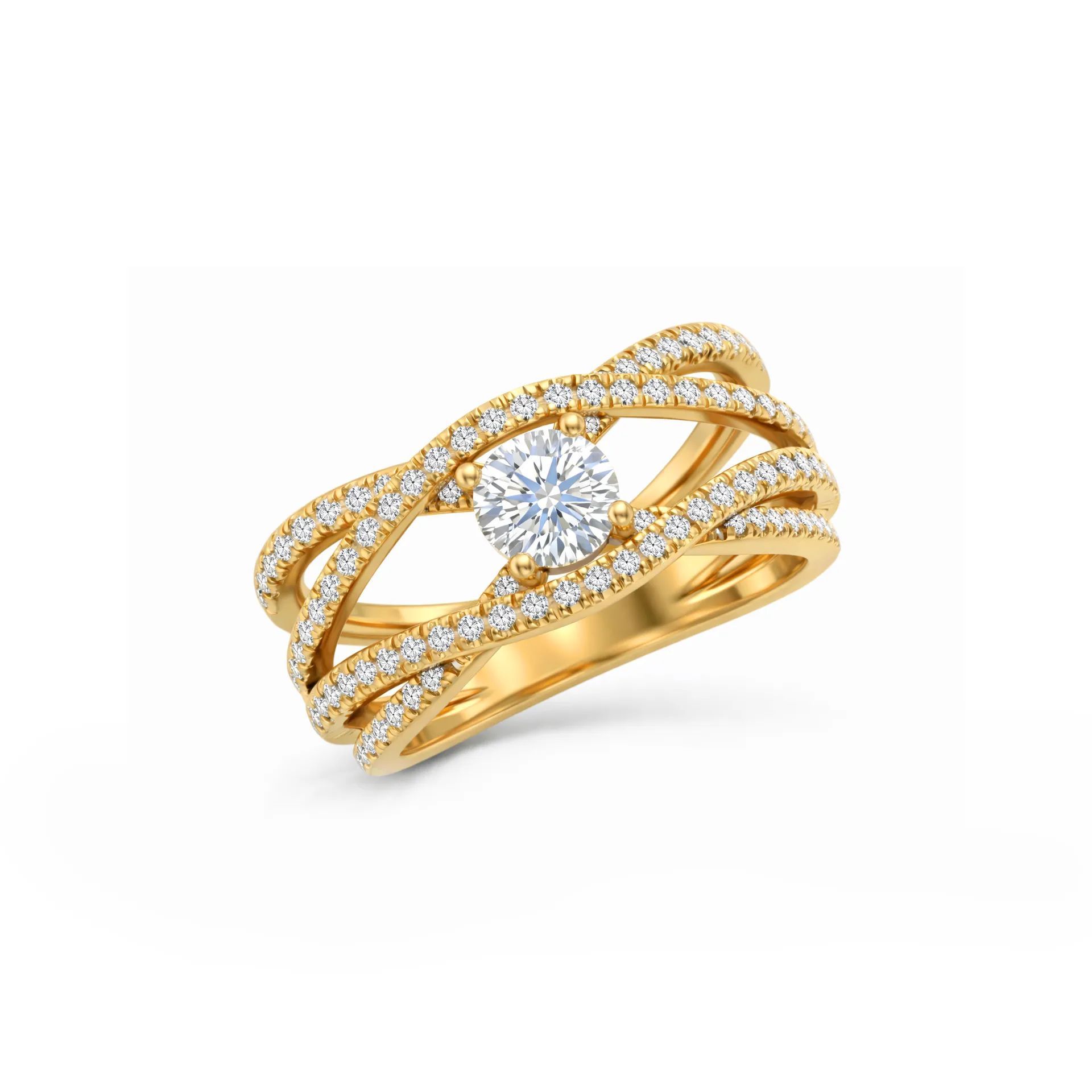
Find lab grown diamond rings that actually feel like you. Ethera breaks down cuts, carats, settings and styles so choosing your ring feels much easier.
You can find the right lab grown diamond rings by deciding four things first: how you want the ring to feel on your hand, which diamond shape catches your eye, how much presence you want, and how you'll actually wear it. Everything else gets much easier once those answers are clear.
Because here's the thing about choosing a ring: you're rarely choosing between a good diamond and a bad diamond. You're choosing between dozens of very good options that somehow look completely different once they're on your finger.
A one-carat round solitaire can feel classic. A one-carat pear can feel sharper and more unexpected. An emerald cut can look restrained from across the room and quietly spectacular when the light hits it. Same category. Entirely different personality.
So rather than starting with what everyone else is wearing, start with what you'd still want to look at five years from now.
How to choose lab grown diamond rings you'll actually love wearing
The best lab grown diamond rings balance the diamond you love with proportions, setting and practicality that suit how you actually live.
Start with the simplest question: when you picture your ring, what do you notice first?
If the answer is the diamond, you'll probably gravitate towards cleaner solitaire or lightly detailed settings. If you notice the overall design, you may prefer halos, unusual bands, clusters or side stones. If you immediately picture a stack, the shape and height of the setting become just as important as the centre stone.
And don't let the phrase lab grown make you think you're choosing a different kind of diamond. Lab grown diamonds are real diamonds, chemically and visually identical to mined diamonds. The difference is where they come from: they're created in a controlled environment rather than extracted from the earth.
That changes the buying equation. You can often explore a larger diamond, a more elaborate design or finer specifications without automatically pushing the budget into territory that makes you uncomfortable.
Your ring should still begin with design, not mathematics.
Start with the cut of diamond, not the carat number
The cut of diamond determines how a stone handles light, while its shape determines the outline you see on your finger.
These two ideas get mixed up constantly.
When jewellers talk technically about cut, they're usually talking about proportions, symmetry and polish, particularly with round diamonds. When you're choosing between round, oval, pear or princess, you're primarily choosing a shape.
And shape changes almost everything about how a ring feels.
Diamond shape | What it tends to look like | Worth considering if you want |
Bright, balanced and familiar | Maximum sparkle and an easy-to-style silhouette | |
Elongated and softly curved | A diamond that can appear larger across the finger | |
Rounded at one end, pointed at the other | Something feminine with a slightly unexpected edge | |
Long, clean lines and broad flashes | A quieter, architectural look | |
Square with crisp corners | Modern geometry with strong brilliance | |
Rounded square with softer edges | A balance between classic and contemporary | |
Other fancy cuts | A ring that doesn't resemble everyone else's |
A round brilliant cut diamond engagement ring remains popular for good reason. Round brilliants are designed with a faceting pattern that returns a great deal of light, so they're usually the obvious choice when sparkle is your priority.
A princess cut takes the same appetite for brilliance somewhere more graphic. Its square outline gives the ring stronger edges and tends to work beautifully in modern settings.
A pear cut introduces direction. Wear the point towards or away from your fingertip and the same stone suddenly has a slightly different character.
Then there are fancy cut diamonds, essentially diamond shapes other than round. Oval, pear, marquise, emerald, cushion and more unusual silhouettes all fall into this broader family.
There's no hierarchy here. The shape that makes you keep moving your hand under the jewellery-store light is probably telling you something useful.
Does one carat actually look like one carat?
Carat measures a diamond's weight, not the amount of surface area you see when you look at the stone from above.
That distinction can save you from choosing a ring entirely by numbers.
Two diamonds can both weigh one carat and still look noticeably different on your finger. Their dimensions, proportions and shapes affect how much visual space they occupy.
An elongated oval or pear, for instance, can spread its weight differently from a round diamond. That may make it appear larger from the top even though both stones have the same carat weight.
This is especially worth remembering if you're searching for a 1 carat diamond wedding ring or engagement ring. Don't stop at the certificate. Look at the millimetre measurements too.
A beautiful one-carat diamond isn't the one with the most impressive number attached to it. It's the one whose proportions make sense once it's actually sitting on your hand.
Solitaire, halo or something less predictable?
A ring setting determines how the diamond is held, how prominent it looks and how comfortably the ring works in everyday life.
The solitaire is the stripped-back answer. One central diamond, very little visual competition. It puts shape and proportion front and centre, which is why solitaire lab grown diamond engagement rings remain such an easy starting point.
A halo surrounds the centre diamond with smaller diamonds. Visually, this creates more brilliance around the centre and can make the overall diamond area feel larger.
Three-stone rings add a different rhythm. The centre diamond remains the focus, but side stones create width across the finger and give you much more room to play with shape combinations.
Then you've got bands with pavé diamonds, bezel settings, east-west settings, asymmetrical designs, toi et moi rings and sculptural styles that treat the diamond as one element of a larger composition.
A famous reference point is Tiffany & Co. engagement rings, particularly the classic raised solitaire aesthetic that helped cement the six-prong solitaire in popular imagination. But you don't need to recreate an iconic ring for your own ring to feel significant.
Borrow the idea you love. Leave the rest.
Don't choose your diamond without thinking about your hand
Diamond proportions can change how a ring visually sits across the finger, so trying different shapes is more useful than relying on photographs alone.
Elongated shapes such as oval, pear, marquise and emerald cuts draw the eye vertically. On some hands, that creates a longer visual line through the finger.
Round and cushion shapes create a more centred look. Princess cuts give you defined geometry, while wider three-stone settings or east-west diamonds create movement across the finger instead.
None of that means there's a prescribed diamond for a particular hand shape. There isn't.
It means scale matters.
A design that looks delicate in a close-up photograph may have considerably more presence when you wear it. Another that seems substantial online may sit surprisingly quietly once you see it at normal viewing distance.
Try rings. Look at your hand from farther away. Move it. Put your phone down and look again.
Jewellery isn't worn at 300% zoom.
Your metal changes more than the colour
The metal you choose affects the ring's colour, durability, weight, maintenance and overall design language.
Yellow gold gives diamonds a warmer frame. White gold creates a cooler, more continuous transition between metal and stone. Rose gold adds a blush tone that can soften geometric designs.
Purity matters too.
For jewellery intended for regular wear, different gold purities offer different balances between pure gold content, strength and price. 9KT gold contains 37.5% pure gold, with other metals added to create an alloy suitable for jewellery.
This is one reason Ethera uses thoughtfully engineered gold settings across designs intended to move beyond occasional wear. Whatever purity you choose, look for proper hallmarking. In India, a BIS hallmark gives you an official reference for the stated purity of the gold.
The prettiest setting in the world won't make you happy if you're constantly worried about wearing it.
Should you choose lab grown diamonds over a diamond alternative?
A lab grown diamond is a real diamond, while a diamond alternative is a different material designed to create a broadly similar visual effect.
This distinction matters.
Moissanite and cubic zirconia, for example, aren't diamonds. They have different chemical compositions, optical properties and hardness levels.
Lab grown diamonds, on the other hand, have the same fundamental crystal structure and chemical composition as mined diamonds. They're simply created through technological processes in controlled environments rather than formed underground and mined.
So if you're considering a diamond alternative because you assume lab grown means imitation, you're comparing two different categories.
The more useful question is whether you want a diamond at all. If the answer is yes, lab grown lets you choose an actual diamond while approaching size, design and budget differently.
How much should you spend on your ring?
The right ring budget is the amount that lets you buy a design you genuinely want without turning the purchase into a financial burden.
Forget salary formulas.
A ring doesn't become more meaningful because it consumed a predetermined number of monthly pay cheques. Decide what you're comfortable spending, then work backwards through the choices that affect price.
With lab grown diamonds, you may find that your budget gives you several routes. You could choose a larger centre diamond. You could keep the centre more restrained and spend on the setting. You could prioritise higher colour or clarity grades. Or you could put the difference towards another piece you'll wear just as much.
There's no prize for maximising every specification.
Think of your budget as a design boundary, not a test you have to pass.
The ring you save on Pinterest isn't necessarily the ring you'll choose
The ring you love in photographs can feel completely different once its scale, height and proportions are translated onto your hand.
Your saved folder is still useful. Very useful, actually.
Look for patterns rather than exact rings. Maybe nearly everything you've saved has elongated diamonds. Perhaps you've accidentally collected twenty yellow-gold solitaires. Maybe every ring has a slim band, or every setting sits low against the finger.
That's your taste revealing itself before you've found the vocabulary for it.
Bring those references when you're shopping or customising. At Ethera, customisation can begin with exactly that kind of visual clue: a silhouette you like, a diamond shape you keep returning to or a setting you'd change slightly if it were yours.
You don't need to arrive speaking fluent jewellery.
You just need to know what keeps catching your eye.
Think about the wedding band before saying yes to the engagement ring
An engagement ring's setting height and shape determine how easily a wedding band can sit beside it.
This is easy to overlook when the engagement ring is currently getting all the attention.
A high-set solitaire often leaves enough space underneath the centre setting for a straight band to sit close beside it. Lower settings, large baskets or unusual shapes can create a gap.
That gap isn't automatically a problem. Some stacks look better with breathing room. Others use a contoured or curved wedding band designed to follow the engagement ring.
If you already know you'll eventually wear both together, try them as a pair before making your final decision.
A ring doesn't live alone just because you bought it first.
What should you check before buying?
Before buying a diamond ring, check the diamond certification, gold hallmark, setting quality, proportions, comfort and after-sales policies.
For significant lab grown diamonds, certification gives you independently assessed information about characteristics such as carat, colour, clarity and cut-related measurements. Ethera uses IGI-certified lab grown diamonds and BIS-hallmarked gold, alongside a 40-point quality check before a piece reaches you.
Then inspect the less glamorous details.
Does the ring feel comfortable between your fingers? Do the prongs catch? Is the diamond set straight? Can you see yourself typing, travelling, getting dressed and going about an ordinary Tuesday while wearing it?
That's where a dream ring earns the name.
Not under showroom lights.
On your hand, somewhere completely ordinary, when you catch yourself looking at it anyway.
FAQs
Are lab grown diamond rings real diamonds?
Yes. Lab grown diamond rings contain real diamonds with the same chemical composition and crystal structure as mined diamonds. They're created in controlled laboratory environments rather than formed underground and extracted through mining. They can also be independently graded for characteristics including carat, colour, clarity and cut.
Are lab grown diamond engagement rings good for everyday wear?
Yes, lab grown diamond engagement rings are suitable for everyday wear because lab grown diamonds have the same fundamental hardness as mined diamonds. The setting matters just as much, though. A secure, well-made setting and sensible care will determine how comfortably your ring handles daily use over time.
Which cut is best for lab grown diamond rings?
There isn't one best diamond cut for every ring. Round brilliant cuts prioritise sparkle, emerald cuts create broad flashes and clean geometry, while oval and pear shapes offer elongated proportions. The best choice is the shape whose appearance, dimensions and setting suit both your taste and your hand.
Is a 1 carat lab grown diamond ring big enough?
A one-carat lab grown diamond can have plenty of presence, but its visible size depends on shape and proportions rather than weight alone. An elongated oval or pear may appear different in size from a one-carat round. Compare millimetre dimensions and try different shapes instead of judging the ring by carat alone.
What's the difference between a lab grown diamond and a diamond alternative?
A lab grown diamond is an actual diamond, while a diamond alternative is made from another material. Moissanite and cubic zirconia, for example, have different chemical and optical properties. Lab grown diamonds share the same essential composition and structure as mined diamonds but are produced in controlled environments.
Are round brilliant or princess cut diamonds better for an engagement ring?
Neither is inherently better. A round brilliant diamond creates a softer outline and is known for strong light return, while a princess cut gives you a square silhouette with crisp geometry. Your choice comes down to whether you prefer the familiar brilliance of a round or the sharper look of a princess.
Can I customise lab grown diamond rings in India?
Yes, lab grown diamond rings can be customised through jewellers that offer made-to-order design services. Depending on the design, you may be able to choose the diamond shape, carat, setting, metal and proportions. Ethera also offers customisation for those who want to turn references or ideas into a more personal piece.
What should I look for when buying lab grown diamond rings online?
Check diamond certification, gold purity and hallmarking, accurate product dimensions, setting details and the jeweller's after-sales policies. Photographs alone don't tell you how large or high a ring will sit, so measurements matter. For larger diamond purchases, an independent grading certificate gives you useful information beyond what you can see online.