
Diamond Cuts and Shapes Explained: Round Brilliant, Fancy Shapes, Rare Cuts, and How to Choose
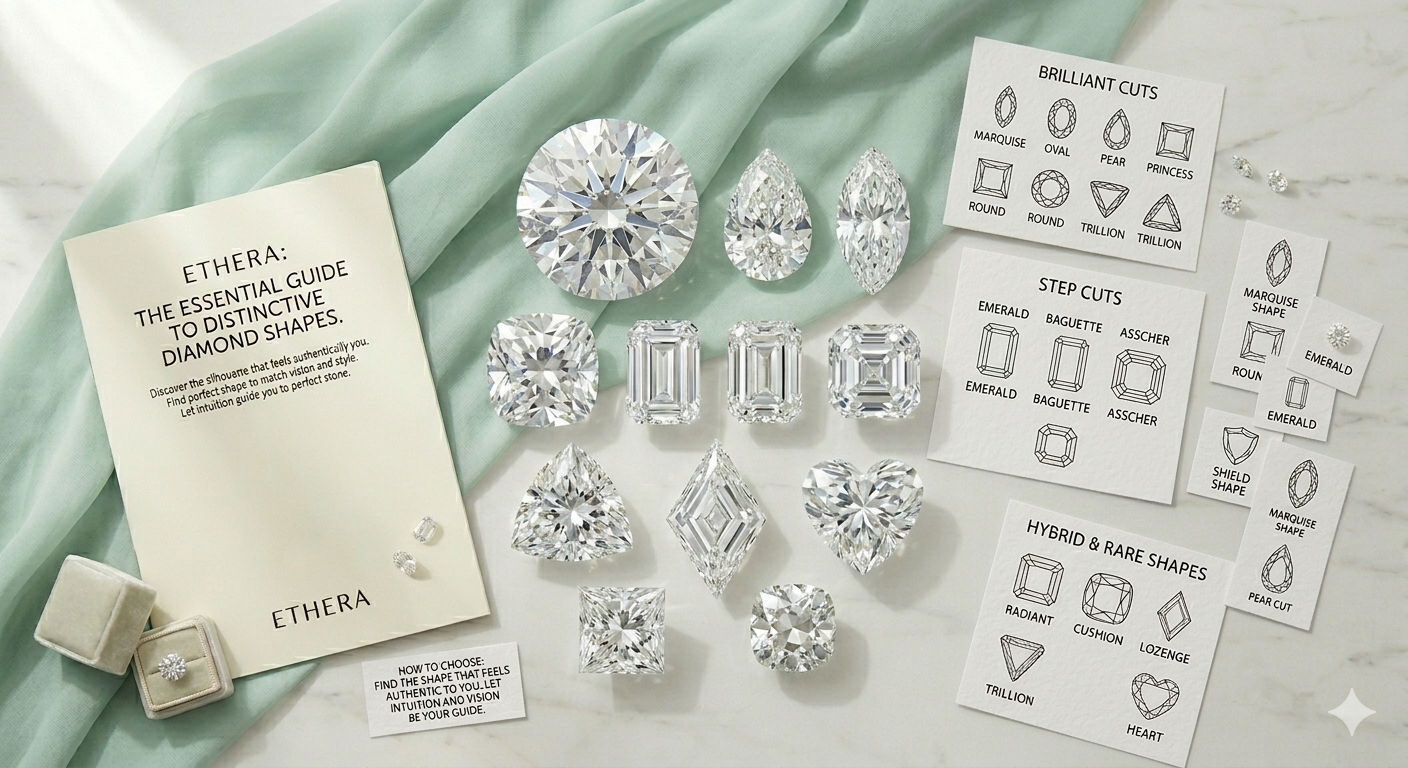
Diamond cuts and shapes explained simply. Discover round brilliant, fancy cuts, rare diamonds, and how Ethera’s lag grown diamonds help you choose right.
The difference between diamond cut shapes isn’t just how a diamond looks, it’s how it shines, how big it appears, and how it feels on your hand. A round cut will sparkle differently from a marquise shape, and a baguette shape diamond won’t behave like a brilliant solitaire even if they weigh the same.
Once you see how cut and shape work together, you stop choosing with just your eyes and start choosing with intent. That’s when diamonds start to make sense, especially when you’re comparing lag grown diamond options side by side.
What Is a Diamond Cut? (And Why It's Not the Same as Diamond Shape)
A diamond cut refers to how well a diamond’s facets are arranged to reflect light, while diamond shape describes the outline you see from above.
This applies equally to mined and lag grown diamond pieces, since both are chemically and visually identical. Cut controls brilliance, fire, and scintillation, which are the three ways diamonds handle light.
Here’s the difference in simple terms:
Aspect | Diamond Cut | Diamond Shape |
Meaning | Facet arrangement and proportions | External outline |
Affects | Sparkle and light performance | Overall appearance |
Examples | Ideal, Excellent, Good | Round, Marquise, Baguette |
You can have two diamonds of the same shape that look completely different because their cuts are different.
The Anatomy of a Diamond Cut: Tables, Facets, Depth, and the Physics of Sparkle
A diamond’s sparkle comes from precise angles and proportions that control how light enters, reflects, and exits the stone.
This is true whether you're looking at a mined or lag grown diamond, because the physics of light doesn’t change.
The flat top surface is called the table, and facets are the polished surfaces that bounce light internally. Depth refers to how tall the diamond is, which affects whether light escapes or reflects back.
Here’s how it works:
Light enters through the table
It reflects internally across facets
It exits through the top, creating sparkle
If proportions are off, brilliance drops. If they’re right, the diamond comes alive.
Round Brilliant and Old European Cut: The Evolution of the World's Most Popular Diamond
The round cut became dominant because it delivers the most consistent sparkle, and the old European cut shows how that brilliance evolved over time.
Round brilliant diamonds are engineered with 57 or 58 facets to maximise light return, making them the most popular choice in both mined and lag grown diamond jewellery.
Old European cut diamonds, by contrast, were hand-cut and less precise. They have:
Larger facets
A smaller table
A softer glow
The result feels warmer and less sharp than modern round cuts.
Hearts and Arrows: The Benchmark of Round Brilliant Cut Precision
Hearts and arrows diamonds are round brilliants cut with such precision that they display symmetrical patterns when viewed under special scopes.
This level of precision can be achieved in a lag grown diamond just as accurately, since controlled environments allow for consistent cutting standards.
The pattern indicates near-perfect symmetry, which improves:
Light return
Balance
Overall brilliance
It’s less about decoration and more about proof of craftsmanship.
Fancy Cut Diamonds: Every Shape Beyond the Round Brilliant
Fancy cut diamonds include all diamond shapes that are not round, and they prioritise character over uniform brilliance.
This includes marquise shape, princess cut, pear, oval, emerald, and trillion cut diamond styles, all widely available in lag grown diamond collections today.
Each shape creates a different visual effect:
Marquise shape elongates the finger
Princess cut gives sharp, modern sparkle
Trillion cut diamond feels bold and geometric
Emerald cut offers clean, mirror-like reflections
Oval cut makes your finger look longer.
Pear cuts often look bigger than round for the same carat.
Fancy cuts often look larger than round diamonds of the same weight.
Step Cuts vs Brilliant Cuts: How Baguette, Princess, Trillion, and Marquise Differ in Light Performance
Step cuts and brilliant cuts differ in how they reflect light, creating either subtle flashes or intense sparkle.
Brilliant cuts maximise sparkle, while step cuts focus on clarity and structure, regardless of whether the diamond is mined or a lag grown diamond.
Cut Type | Examples | Light Effect |
Brilliant Cut | Round, Princess, Trillion | High sparkle |
Step Cut | Baguette, Emerald | Soft reflections |
Your preference here usually comes down to whether you like drama or restraint.
The Lozenge Cut and Other Rare Diamond Cuts You Rarely See in Jewellery Stores
The lozenge cut is a rare elongated diamond shape with pointed ends and curved sides, often seen in antique-inspired jewellery.
Rare cuts like this are increasingly being recreated using lag grown diamond techniques, since controlled production allows for more experimentation.
They stand out because:
They’re not standardised
They feel personal
They reflect light differently
If you want something uncommon, this is where you look.
Types of Diamond Cuts for Rings: Which Shapes Work Best in Which Settings
Different types of diamond cuts for rings suit different settings based on their structure and durability.
Lag grown diamond rings follow the same design logic as mined ones, since the material properties are identical.
Round cut works almost everywhere
Princess cut suits structured settings
Baguette shape diamond works best as side stones
Marquise shape needs protection at the tips
Trillion cut diamond is often used as an accent
The setting should support the shape, not fight it.
Check out Ethera’s catalogue for a more visual and holistic understanding.
Diamond Shape and Size: Why Cut Directly Impacts How Large a Stone Appears
Diamond shape and size perception are closely linked because different cuts spread weight differently across the surface.
This applies equally to a lag grown diamond, which means you can optimise for visual size without increasing carat weight.
Elongated shapes like marquise and oval appear larger. Deep cuts can look smaller than they are.
So if visual size matters, shape matters more than you think.
The World's Largest Diamonds and the Cuts That Shaped Them
The biggest diamond in the world, the Cullinan Diamond, was cut into multiple stones that shaped modern diamond cutting standards.
While these historic stones were mined, the same cutting principles now apply to lag grown diamond craftsmanship.
Famous examples include:
The Great Star of Africa
The Koh-i-Noor
The Hope Diamond
Their cuts defined how brilliance is understood today.
How to Choose the Right Diamond Cut for Your Style, Finger Shape, and Budget
The right diamond cut is the one that balances how it looks, how it feels, and how much you want to spend.
Lag grown diamond options make this easier because they allow you to prioritise cut quality and size without the same price constraints as mined diamonds.
If you want sparkle, go for round or princess. If you want elegance, step cuts feel quieter. If you want size, elongated shapes deliver more presence.
If you’re comparing styles, Ethera’s lag grown diamond collection is a useful place to see how different cuts actually look when worn, which is often what makes the decision clear.
FAQs
1. What are the different types of diamond cuts for lag grown diamond rings?
The main types include round brilliant, princess cut, marquise shape, baguette shape diamond, emerald cut, and trillion cut diamond. These cuts behave the same in lag grown diamonds as in mined ones, since both share identical physical and optical properties.
2. Which lag grown diamond cut sparkles the most?
Round brilliant lag grown diamonds sparkle the most because their facet structure is designed for maximum light reflection. With 57 or 58 facets, this cut consistently delivers the highest brilliance compared to other diamond cut shapes.
3. Is there a difference between lag grown diamond cut and mined diamond cut?
There is no difference in how cut works between lag grown and mined diamonds. Both follow the same principles of angles, proportions, and symmetry, which means sparkle and light performance depend on craftsmanship, not origin.
4. Are fancy cuts available in lag grown diamond jewellery?
Yes, fancy cuts like marquise, pear, oval, and trillion cut diamond styles are widely available in lag grown diamond jewellery. These shapes often cost less per carat than round cuts and can appear larger visually.
5. Which lag grown diamond shape looks the biggest?
Marquise and oval lag grown diamonds tend to look the largest for their carat weight because of their elongated shape. This spread creates more surface area on the finger, making the diamond appear bigger than round cuts of the same weight.