
Statement Cocktail Rings: How to Choose and Style Cocktail Rings
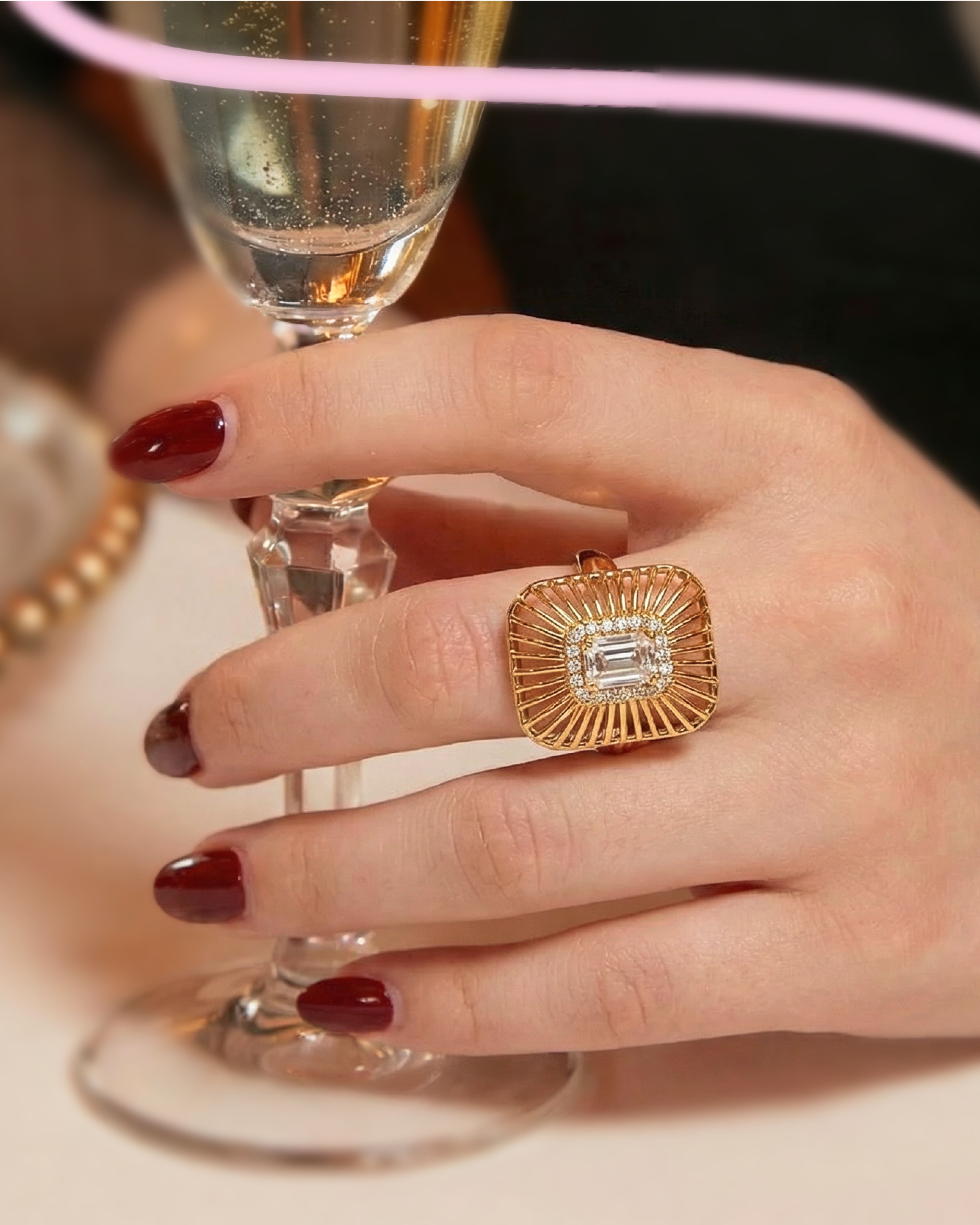
Statement cocktail rings are bold, decorative rings designed to become the focal point of your jewellery rather than quietly complementing it.
The right one should feel striking on your hand without being uncomfortable, difficult to style or reserved for a party that may never materialise.
That last part matters. Cocktail statement rings may have begun as evening jewellery, but modern versions aren’t waiting patiently beside your sequinned dress. You can wear one with a silk sari, a sharply cut trouser suit, a linen shirt or the black dress you’ve already worn to four weddings.
The trick is choosing a ring that looks intentionally dramatic, not simply large.
What are statement cocktail rings?
Statement cocktail rings are oversized or visually distinctive rings created to attract attention through scale, shape, diamonds, colour or sculptural metalwork.
Cocktail rings became closely associated with the social changes of 1920s America, when women wore conspicuous rings to speakeasies during Prohibition. Their size made them visible as women raised their glasses, turning the ring into a small signal of independence and rule-breaking style.
The modern version has kept the confidence and lost the dress code. You no longer need a cocktail in your hand to justify the ring on it.
Ring type | Typical appearance | Main purpose |
Large, decorative and visually dominant | Personal style and self-expression | |
Any ring with a strong visual identity | Creating a focal point | |
One prominent centre diamond | Highlighting the centre stone | |
Several stones arranged as one composition | Creating width, detail and sparkle | |
Usually centred around commitment symbolism | Marking an engagement |
The difference between a cocktail ring and a statement ring is mostly one of tradition. Cocktail rings are a type of statement ring, usually associated with larger proportions and decorative designs. A statement ring can also be architectural, minimal or entirely metal-led.
How cocktail statement rings create impact
Cocktail statement rings create impact by controlling where your eye lands, usually through size, contrast, symmetry or an unexpected silhouette.
A large diamond is one route, but it isn’t the only one. A marquise-shaped cluster can cover more of the finger than a heavier round stone. A floral arrangement can make several modest diamonds appear like one expansive design. Negative space, where parts of the finger remain visible between elements, can make a ring feel larger without turning it into a solid block of gold.
Here’s how the main design approaches differ:
Design approach | What creates the drama | How it feels on the hand |
Scale and concentrated brilliance | Clean, confident and polished | |
Smaller diamonds surrounding a centre stone | Bright and visually expansive | |
Multiple stones forming a single shape | Detailed and high-sparkle | |
Petal-like stones or organic outlines | Expressive and feminine | |
Angles, lines and symmetry | Modern and architectural | |
Movement and negative space | Contemporary and unexpected |
The carat weight alone doesn’t tell you how striking a ring will look. Carat measures a diamond’s weight, not its visible size or the total area the design covers.
How to choose a statement cocktail ring for your hand
The most flattering statement cocktail ring is one whose proportions work with your fingers while still delivering the level of drama you enjoy.
There’s no hand shape that “can’t” wear a large ring. That idea belongs in the same cupboard as saving diamonds for special occasions. Proportion simply helps you choose between different kinds of boldness.
Longer, vertical designs such as marquise, oval, pear-shaped or leaf-inspired rings can visually extend shorter fingers. Wide floral clusters and horizontal arrangements create more coverage across longer fingers. Angular designs can give soft, rounded hands greater definition, while curved motifs create an appealing contrast against prominent knuckles.
These are useful starting points, not laws issued by the jewellery police.
What you want | Design worth trying |
A longer-looking finger | Vertical oval, pear or marquise arrangement |
More finger coverage | Wide cluster or floral composition |
A cleaner statement | Large solitaire or geometric design |
A softer look | Curved lines, petals and rounded settings |
Something unconventional | Asymmetry, mixed shapes or negative space |
Maximum sparkle | Pavé, halo or multi-diamond cluster |
Try the ring from more than one angle. A design that looks spectacular from above may sit too high from the side. Check whether you can bend your finger comfortably, reach into a bag and hold your phone without the ring rotating.
A slightly wider band can help stabilise a substantial top section. A ring that repeatedly spins isn’t necessarily the wrong size. Its centre may simply be too top-heavy for the band supporting it.
Which diamond shapes work best in cocktail rings?
Diamond shapes with distinctive outlines work especially well in cocktail rings because the silhouette remains visible even from a distance.
Round brilliant diamonds give you intense, evenly distributed sparkle. Their familiar shape makes them useful in floral clusters and symmetrical halos, where several diamonds need to read as one balanced design.
Oval diamonds combine brilliance with an elongated outline. Set vertically, they can lengthen the finger. Turned east-west, meaning placed horizontally across the band, they create a wider and more contemporary ring.
Marquise diamonds have pointed ends and a long, narrow body. They work beautifully as centre stones, leaves or petals. Because those tips are more exposed, they need protective prongs or a bezel-style edge that reduces the risk of chipping.
Emerald-cut diamonds use long, rectangular step facets instead of the smaller triangular facets seen in brilliant cuts. They produce broad flashes of light rather than constant glitter, which gives a cocktail ring a calmer, more architectural presence.
Pear-shaped diamonds can appear elegant, directional or playfully asymmetric depending on how they’re positioned. Several pear diamonds placed around a centre can create a flower, starburst or fan without needing coloured stones.
A mixed-shape ring combines cuts such as marquise, pear, round and baguette diamonds. It’s one of the easiest ways to make a design feel intricate without covering every visible space in metal.
Choosing a setting that suits your lifestyle
Prong settings hold a diamond with small metal claws. Four prongs reveal more of the stone, while six offer greater security if one prong is damaged. Prongs maximise visibility and light, but raised designs can catch on fine knits, hair or the inner lining of a handbag.
A bezel setting surrounds all or part of the diamond with a thin metal rim. It gives the stone more edge protection and creates a smooth outline, although it may allow less light to enter than a minimal prong setting.
Pavé is a surface setting in which small diamonds are placed close together with very little metal visible. It creates continuous sparkle, making it useful across petals, bands and halo details.
A gallery rail is a supporting metal structure beneath or around the diamonds. You may not notice it from above, but it can help keep larger arrangements secure.
Before buying, check four practical details:
The ring shouldn’t scrape the neighbouring fingers when your hand is relaxed.
The setting shouldn’t have sharp edges that catch on clothing.
The top shouldn’t rotate constantly during ordinary movement.
The diamonds should be protected at exposed corners and pointed tips.
A beautiful ring shouldn’t require you to hold your hand like it’s carrying a tiny ceremonial crown.
Can statement cocktail rings be worn every day?
Statement cocktail rings can be worn every day when their height, setting and proportions suit your routine.
A low-profile cluster will usually be easier to live with than a towering solitaire. Smooth edges are more practical than elaborate projecting details if you type, travel or reach into bags throughout the day. A secure bezel or closely fitted prong arrangement can also be easier to manage than an extremely open setting.
That doesn’t mean your everyday ring has to be restrained. It means the drama should come from design rather than inconvenience.
For frequent wear, look for a ring that:
sits securely without spinning;
has no exposed sharp corners;
leaves enough space to bend your finger;
can be cleaned around and underneath the diamonds;
doesn’t clash painfully against neighbouring rings.
You should still remove it before strength training, gardening, heavy cleaning or handling chemicals. Diamonds are highly durable, but settings can bend and gold can scratch. Store the ring separately rather than letting it rattle against earrings, chains or other rings.
To clean it at home, soak it briefly in lukewarm water with mild washing-up liquid, use a very soft brush around the setting and rinse carefully. Avoid cleaning over an open drain. That plot twist has no satisfying ending.
How to style a cocktail ring without overdoing it
The easiest way to style a cocktail ring is to make it the clear focal point and keep the jewellery nearest to it relatively quiet.
A large ring with small diamond studs often looks more deliberate than a large ring, chandelier earrings, a wide necklace and a stack of bangles competing for the same patch of daylight.
That said, balance doesn’t mean everything else has to disappear. It means the pieces should have different visual roles.
Outfit | Styling approach |
White shirt and trousers | Add one geometric ring |
Black dress | Pair a bold ring with a fine necklace |
Silk sari | Choose a ring that picks up one shape from your earrings |
Printed kurta set | Use a clean solitaire or structured cluster |
Evening suit | Try an east-west or asymmetric design |
Wedding guest look | Pair a larger cocktail ring with lighter wristwear |
You can wear the ring on either hand. Traditionally, cocktail rings are often worn on the right hand to separate them from engagement and wedding rings, but there’s no functional requirement to do so.
The middle finger offers space and symmetry for wider designs. The index finger makes a ring feel more expressive, particularly when you speak with your hands. The ring finger suits narrower cocktail designs, while the little finger works best with compact statement rings that won’t overwhelm it.
If you wear a cocktail ring beside a stack, leave a bare finger between them or keep the stack slim. Empty space is doing useful work. Let it.
How to choose between 9KT, 14KT and 18KT gold
The difference between 9KT, 14KT and 18KT gold is the percentage of pure gold in the alloy, which affects colour, price, weight and resistance to everyday wear.
A karat measures gold purity. Pure gold is 24KT, but it’s generally alloyed with metals such as silver, copper or zinc to make jewellery more practical.
Gold purity | Pure gold content | Useful quality in a cocktail ring |
9KT | 37.5% | Durable and well suited to frequent wear |
14KT | 58.5% | Balanced colour, strength and gold content |
18KT | 75% | Richer gold colour and higher gold purity |
A substantial cocktail ring can contain more metal than a slim everyday band, so karatage can noticeably affect its final price and weight. A 9KT setting may suit you when you want a larger, lighter design for regular wear. An 18KT setting may appeal when a richer gold tone is central to the look.
All three are real gold when correctly hallmarked. In India, check for the BIS hallmark and the corresponding purity mark, such as 375 for 9KT, 585 for 14KT or 750 for 18KT.
Why lab grown diamonds work particularly well in cocktail rings
Lab grown diamonds make it possible to explore larger and more diamond-intensive cocktail-ring designs without changing what a diamond is.
They’re real diamonds with the same chemical, physical and optical properties as mined diamonds. The difference is their origin: they’re created in a controlled environment rather than extracted from the earth.
This matters in cocktail rings because these designs often use more diamonds, greater visible coverage or unusual combinations of shapes. Instead of shrinking the design to fit a traditional diamond budget, you can focus more freely on proportion, silhouette and how the ring looks across your hand.
You should still judge lab grown diamonds using familiar quality factors. Cut affects how effectively a diamond returns light. Colour describes how colourless it appears. Clarity records internal and external characteristics. Carat measures weight.
Certification is particularly useful when a ring contains a substantial centre diamond. It provides an independent record of the stone’s specifications rather than asking you to rely solely on how large or bright it looks under store lighting.
Ethera’s lab grown diamond cocktail rings are designed around this idea: real diamonds, considered proportions and enough visual personality to make the ring worth looking at twice. You can also browse Ethera’s wider diamond ring collection for women if you’re deciding between a full cocktail design and a cleaner statement ring.
The best cocktail ring is the one you won’t save
A cocktail ring should feel a little more expressive than the jewellery you’d choose on autopilot. That’s its job.
But “bold” doesn’t have to mean impractical, heavily embellished or limited to wedding season. It might be a clean oval diamond turned sideways. A flower built from marquise cuts. An open ring that leaves flashes of skin between diamonds. A shape that makes a plain shirt suddenly look planned.
Choose the one that makes you move your hand just to catch another look. Then wear it somewhere thoroughly ordinary.
Frequently Asked Questions
What are statement cocktail rings used for?
Statement cocktail rings are worn to create a strong visual focal point and express personal style. Unlike engagement or wedding rings, they don’t need to mark a relationship or formal milestone. You can wear one for a celebration, with workwear or simply because an otherwise simple outfit needs more character.
What is the difference between cocktail rings and statement rings?
A cocktail ring is a type of statement ring traditionally associated with oversized stones, elaborate clusters and evening dressing. “Statement ring” is a broader term covering any visually distinctive ring, including minimal architectural designs. Every cocktail ring makes a statement, but not every statement ring follows the classic cocktail-ring style.
Which finger should a woman wear a cocktail statement ring on?
A cocktail statement ring can be worn on any finger where it feels balanced and comfortable. The right-hand middle or index finger is popular because it provides space for larger designs and keeps the ring separate from wedding jewellery. Your ring’s width and structure matter more than traditional finger rules.
Can you wear statement cocktail rings during the day?
Yes, you can wear statement cocktail rings during the day, including with officewear and casual clothes. Choose a lower setting with smooth edges if you’ll be typing, travelling or using your hands frequently. Pair it with simpler nearby jewellery so the ring looks intentional rather than crowded.
How large should a cocktail statement ring be?
A cocktail statement ring should be large enough to create visual presence without restricting movement or rubbing against neighbouring fingers. There’s no required carat weight or diameter. A wide cluster of smaller diamonds can look more dramatic than a heavier solitaire, so judge the ring by coverage, comfort and proportion.
Are lab grown diamonds suitable for cocktail rings?
Yes, lab grown diamonds are particularly suitable for cocktail rings because they’re real diamonds with the same chemical, physical and visual properties as mined diamonds. Their controlled-environment origin can make diamond-heavy clusters, larger centre stones and mixed-shape designs more accessible without reducing the scale or detail of the design.
How do you style a cocktail ring with other jewellery?
Style a cocktail ring by giving it a clear visual role and keeping nearby pieces lighter. Small studs, a fine chain or a slim bracelet usually create enough balance. You can still mix metals or wear several rings, but leave some space around the main design so its silhouette remains easy to see.
How should a diamond cocktail ring be cleaned?
Clean a diamond cocktail ring with lukewarm water, mild washing-up liquid and a very soft brush. Gently clean beneath the stones, where lotion and residue often collect, then rinse and dry it with a lint-free cloth. Remove the ring for heavy cleaning, workouts and tasks that could bend its setting.