
We let 5 women design their own Ethera ring. Here’s what they each chose, and why
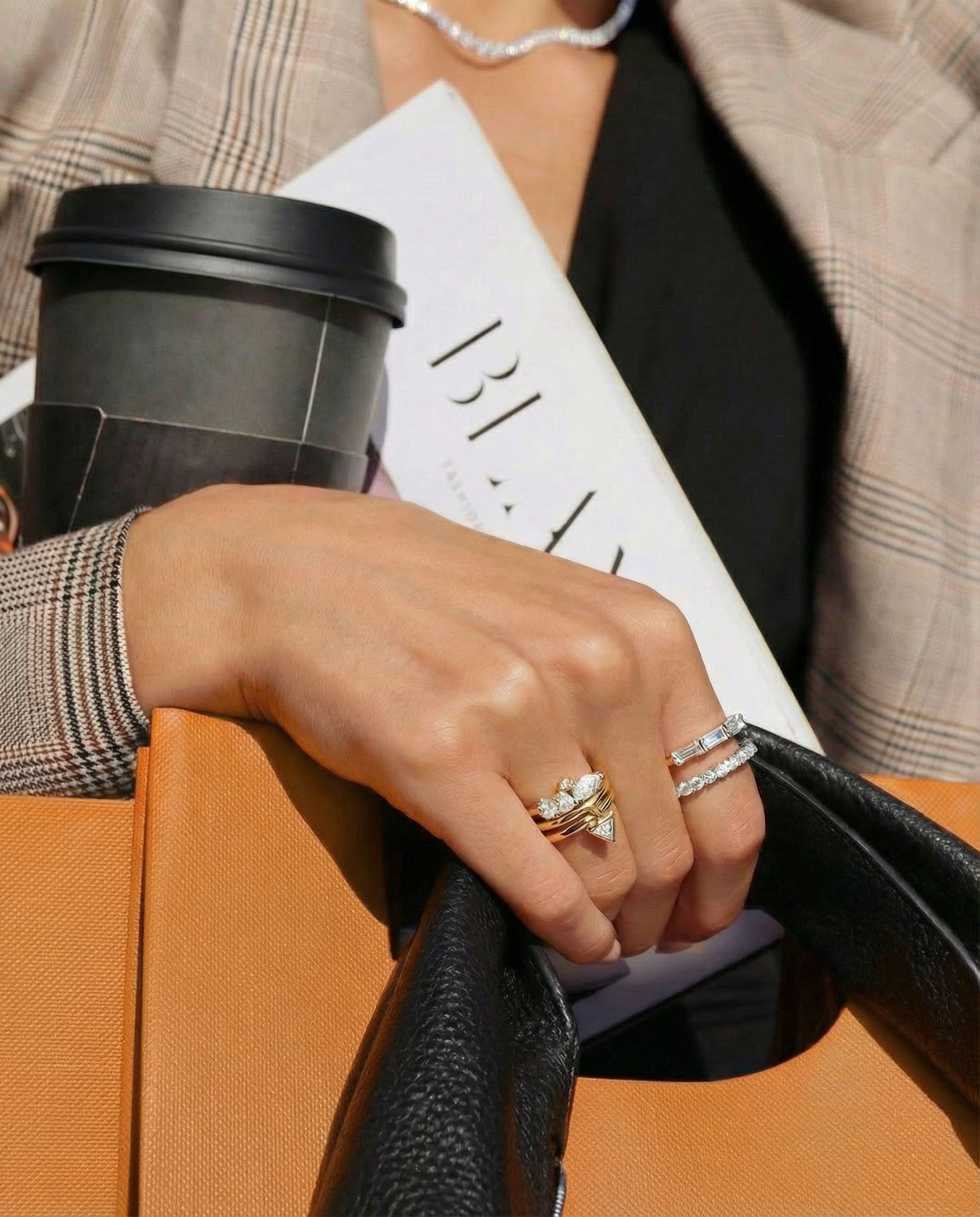
Five women, five very different ring personalities. See the Ethera designs they chose and what each ring design drawing revealed about them.
Give five women the same ring design drawing exercise and you won’t get five slightly different solitaires. You’ll get five entirely different ideas about what a ring should say.
That’s what happened when we asked five women to imagine their own Ethera ring. One wanted clean lines and absolutely no unnecessary detail. Another wanted a ring that looked as though it had wandered out of a garden. Someone chose two pear-shaped diamonds because a single centre stone felt too predictable. One wanted movement. One wanted drama.
Their choices weren’t only about ‘the cut of diamonds or the size of the centre stone. Each decision reflected how they dress, what they notice and how comfortable they are with being noticed themselves.
The final designs already exist in Ethera’s collection, which means you can borrow more than the idea.
The quiet minimalist chose the Orbit Arc Ring
A minimalist ring design uses shape, spacing and proportion to create interest without depending on elaborate decoration.
Ananya’s first instruction was simple: “Nothing floral, nothing fussy and nothing that looks like it’s trying too hard.”
Her wardrobe follows much the same logic. White shirts, straight trousers, silver-toned watches and shoes that somehow remain spotless through an entire Bengaluru monsoon. She rarely wears more than one piece of jewellery at a time, so the ring had to hold its own without becoming the loudest thing in the room.
Her early ring design drawing was mostly curves and empty space. There was no obvious centrepiece, no halo and no row of diamonds marching neatly across the finger. What she kept returning to was an arc: a clean line that appeared to move around the finger rather than sit heavily on top of it.
The Orbit Arc Ring was the natural match. Its open, sculptural form feels considered from every angle, but it doesn’t rely on visual noise to make an impression. It’s the kind of ring you notice gradually, usually when the hand moves.
That restraint is exactly what appealed to her. A conventional engagement design often concentrates all its attention on one central diamond. The Orbit Arc distributes that attention across the composition instead. Your eye follows the line.
It also works for someone who doesn’t want her ring to dictate the rest of her jewellery. It can sit alone on the hand, but it won’t start an argument with a watch, slim bracelet or another ring worn beside it.
Ananya didn’t want a ring that announced itself before she did. She wanted one that looked precise, modern and quietly certain. The Orbit Arc does that without adding a single unnecessary flourish.
The romantic chose the Marquise Meadow Statement Ring
A nature-inspired statement ring combines recognisable organic forms with carefully arranged diamonds rather than copying a flower or leaf literally.
Meher arrived with the most detailed references. There were photographs of wildflowers, old botanical illustrations, embroidered vines and one rather ambitious sketch of a ring that appeared to contain an entire garden.
She loves jewellery with softness, but not the sugary kind. A standard floral cluster felt too symmetrical. A plain round brilliant diamond felt too expected. She wanted the design to look as though it had grown into its shape rather than been arranged with a ruler.
Her choice was the Marquise Meadow Statement Ring.
Marquise-cut diamonds naturally lend themselves to organic designs because their elongated shape resembles petals and leaves. A marquise cut has two pointed ends and a curved centre, giving it a longer profile than a round cut of similar carat weight. When several are arranged at different angles, the composition begins to feel botanical without becoming an obvious flower.
That difference mattered to Meher. She didn’t want a ring that looked bridal in the conventional sense. She wanted something romantic enough to feel personal, but interesting enough to wear with clothes that weren’t remotely romantic.
The Meadow design also shows why fancy-cut diamonds can be more expressive than a single classic shape. “Fancy cut” refers to any diamond shape other than the round brilliant. Marquise, pear, oval, emerald, princess and triangular cuts all fall into this category. Their outlines become part of the design rather than simply providing sparkle.
Meher’s ring isn’t centred around one dominant stone. Instead, your eye moves across several diamond forms. It feels lush, a little unruly and unmistakably hers.
If you want the same idea but a more subtle version see- Wild Vine Solitaire Ring.
The sentimental one chose the Twin Dew Pear Diamond Ring
A toi-et-moi ring places two diamonds within the same design, often using the pairing to represent two people, two chapters or two parts of the wearer’s identity.
Rhea began with meaning before she thought about shape. She wanted two diamonds.
Not because two would look larger than one, although they do create more visual presence. She liked the idea that neither stone had to be treated as the supporting character. The ring could hold two forms in conversation with each other.
Her ring design drawing showed two teardrop shapes angled towards one another. Those eventually became the Twin Dew Pear Diamond Ring.
A pear-cut diamond combines the rounded brilliance of a traditional round cut with a tapered point. Its asymmetrical outline makes it particularly expressive because the direction of the point changes the personality of the design. Two pear-shaped diamonds can mirror each other, face away from one another or meet at an angle.
Rhea chose the pairing because it reminded her of the two versions of herself she’s spent years learning to reconcile: the woman who likes stability and the woman who keeps booking one-way flights.
That might sound unusually philosophical for a ring, but sentimental jewellery works best when the meaning isn’t visible to everyone else. To anyone looking at it, the Twin Dew is a graceful two-stone design. To her, the placement is the point.
The two pear cuts also offer a more fluid alternative to the symmetry of two round diamonds. Round brilliant diamonds are engineered for maximum sparkle through a symmetrical arrangement of facets. Pear diamonds retain plenty of brilliance, but their distinctive outline gives the overall ring more movement.
Rhea didn’t engrave an explanation inside the band. She didn’t need to. The design already carried it.
Also see the Double Embrace Toi-et-Moi Ring featuring an emerald cut diamond next to a pear cut diamond for the best kind of contrast.
The maximalist chose the Crissglow Ring
A bold diamond ring creates impact through scale, intersecting lines and concentrated brilliance rather than relying only on a very large centre stone.
Tara rejected the word “subtle” before we had even opened the sketchbook.
She wasn’t interested in a delicate band that disappeared when viewed from more than two metres away. She wears oversized cuffs with linen shirts, red lipstick at breakfast and sunglasses that require their own travel case. Her ring was never going to whisper.
Still, she didn’t want a predictable cocktail ring. One enormous stone surrounded by a halo felt too static. She wanted the design to move across the finger and reveal different details depending on the angle.
The Crissglow Ring gave her the presence she wanted without falling back on a conventional oversized solitaire.
Its crossing structure creates the sense that several lines are wrapping around the finger. This gives the ring width and visual weight, while the diamonds catch light across more than one plane. The result is bold, but not bulky for the sake of it.
Tara’s choice also highlights the difference between diamond size and design impact. A ring doesn’t necessarily need the largest possible centre stone to look significant. The spread of the setting, the direction of its lines and the placement of smaller diamonds can change how large or dramatic it appears on the hand.
That’s why some statement rings feel more distinctive than engagement designs built around a single high-carat stone. The designer has more territory to play with.
Tara wanted her ring to remain visible while she talked with her hands, which she does often and at considerable speed. Crissglow wasn’t merely acceptable. It seemed structurally prepared for the assignment.
The modern traditionalist chose the Sculpt Crest Solitaire Ring
A contemporary solitaire keeps one diamond as the focal point while changing the setting, band or profile to make the familiar format feel more individual.
Ira was the only woman who knew from the beginning that she wanted a solitaire.
She likes tradition. She just doesn’t believe tradition should be copied without editing. Her references included classic Tiffany & Co. engagement rings, old family jewellery and several sharply architectural ring profiles. She wanted the emotional clarity of a solitaire, but not a design that could belong to anyone.
The Sculpt Crest Solitaire Ring struck that balance.
A solitaire ring features one principal diamond rather than a cluster of similarly prominent stones. The simplicity directs attention towards the diamond’s cut, proportions and setting. That doesn’t mean all solitaires look alike. A sculptural band or distinctive prong arrangement can completely alter the mood.
Ira was particularly interested in the ring’s side profile. Most ring photographs are taken from above, but the wearer sees the ring from many other angles throughout the day. The gallery, which is the structure beneath the centre diamond, can make a solitaire feel delicate, architectural, vintage or contemporary.
This is also where custom engagement designs often become personal. Two rings may both feature a round brilliant diamond, yet look entirely different because one uses a fine straight band while the other rises into a more sculpted setting.
Ira chose the crest-like form because it framed the centre stone without surrounding it with extra decoration. The diamond remained the reason for looking, but the structure rewarded a second glance.
For her, that was the ideal balance: recognisable from across the room, individual once you came closer.
To make it a bit more personalised you can play with the shape of your diamond, look at fancy cuts such as princess cut, cushion cut, or a heart shape if that is more your vibe.
What their ring design drawings had in common
A useful ring design drawing records how you want the ring to feel before it settles questions of carat, gold colour or exact diamond placement.
The five first sketches looked nothing alike, but each began with an instinct rather than a specification.
Ananya drew clean curves, Meher drew leaves because she wanted softness with irregularity. Rhea began with two stones because meaning mattered more than convention. Tara drew wide intersecting lines because she wanted presence. Ira drew a single raised diamond because she wanted tradition with better tailoring.
None of them began by asking for the largest stone available.
That’s useful to remember when you’re looking at different-cut diamonds. The most familiar option isn’t automatically the right one, and the rarest-looking shape isn’t automatically the most personal. A round cut may suit you because of its symmetry and brilliance. A fancy cut may suit you because its outline becomes part of the story.
Certification matters, but it serves a different purpose from design. A grading report from an independent laboratory such as the International Gemological Institute records characteristics including colour, clarity, cut and carat weight. GIA-certified diamond is a popular search term because the Gemological Institute of America is another recognised grading authority. The certificate helps you understand the stone. It can’t tell you whether you’ll still enjoy looking at the ring five years later.
That part begins with taste.
Ethera’s lab-grown diamonds are real diamonds with the same chemical and visual properties as mined diamonds, but they’re grown in a controlled environment instead of being extracted from the earth. This allows the design conversation to begin with what you genuinely like rather than what you believe you’re supposed to choose.
The best ring design looks like its wearer
Your ring doesn’t need to contain your entire personality. It should simply feel unsurprising on your hand.
That may mean an architectural arc, a loose arrangement of marquise diamonds, two pear cuts, a wide crossing form or a solitaire with an unexpected profile. The strongest choice is rarely the one that ticks the greatest number of jewellery trends. It’s the one you’d recognise as yours even without seeing your name beside it.
Start with the detail you’re most certain about. It could be the shape, the amount of sparkle, the width on your finger or even the fact that you don’t want a traditional engagement ring at all.
The drawing can be rough. Taste usually arrives before artistic ability does.
Frequently asked questions
How do I make a ring design drawing if I can’t sketch?
Start with basic shapes and written notes rather than trying to create a polished jewellery illustration. Or take help from the Ethera team for your perfect customised ring.
Which diamond cut is best for a unique ring design?
Fancy-cut diamonds usually offer more distinctive design possibilities because their outlines influence the entire ring. Pear, marquise, emerald, princess and cushion stone ring designs can feel more individual than a classic round solitaire. The best shape still depends on whether you prefer symmetry, softness, sharp lines or visible movement.
What’s the difference between a round cut and a round brilliant diamond?
A round cut describes the diamond’s circular outline, while round brilliant refers to the specific facet arrangement designed to maximise light return. In modern jewellery, the terms are often used interchangeably. The round brilliant remains popular because its symmetry creates strong sparkle and suits solitaire, halo and multi-stone settings.
Can I use Arabic ring design or Krishna ring design references for a custom ring?
Yes, cultural references can guide a custom ring, but they work best when translated thoughtfully rather than copied literally. Arabic ring design may inspire calligraphic curves or geometric repetition, while a Krishna ring design might use a flute, peacock feather or symbolic motif within a wearable contemporary form.
Are lab-grown diamonds suitable for custom engagement designs?
Yes, lab-grown diamonds are real diamonds and can be used in the same settings and cuts as mined diamonds. They’re chemically and visually identical, but created in a controlled environment. You can choose round, princess, pear, marquise and other fancy cuts depending on the design and practical setting requirements.
Is a GIA-certified diamond necessary for a custom ring?
A diamond should have a report from a respected independent grading laboratory, but it doesn’t necessarily have to be GIA-certified. Ethera jewellery uses IGI-certified diamonds. The report records the stone’s colour, clarity, cut and carat weight, helping you compare quality while the ring design determines its final appearance.
What should I consider before choosing a triangle stone ring design?
Check how the pointed corners are protected, how high the stone sits and whether the shape feels comfortable during daily wear. Triangle-cut diamonds have a sharp, graphic appearance, but their points require a secure setting. Their unusual geometry works especially well in modern solitaires and asymmetrical multi-stone rings.
Can Ethera customise an existing ring design?
Yes, Ethera offers bespoke jewellery design services and allows elements such as gold karatage, diamond colour and clarity to be customised. You can begin with an existing Ethera ring and discuss changes that suit your preferences, although feasibility will depend on the structure, setting and diamond arrangement of that design.