
Gold and Lab Grown Diamonds: What the 916 Hallmark Tells You (And Why You Should Always Check)
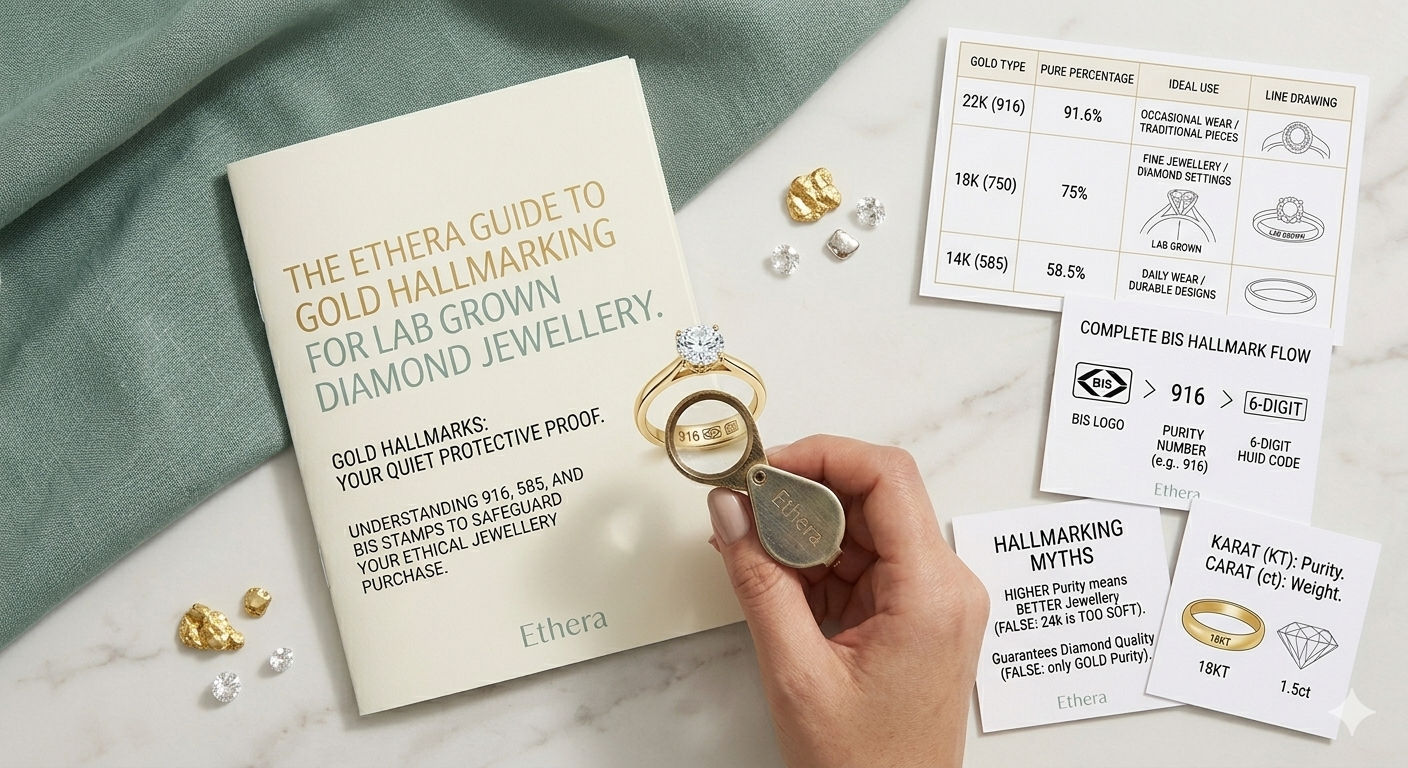
Hallmarked gold protects your purchase. Here’s what 916, 585, and BIS stamps mean for lab grown diamond jewellery at Ethera.
Gold and Lab Grown Diamonds: What the 916 Hallmark Tells You (And Why You Should Always Check)
The 916 hallmark tells you that your gold is 91.6% pure, which directly affects how your lab grown diamond jewellery looks, wears, and holds up over time. If you’re buying a piece that’s meant to last, the hallmark isn’t a small detail. It’s the difference between certainty and guesswork.
Most people focus entirely on the diamond. That makes sense. But the gold holding it in place is doing more work than you think. It determines durability, colour, and even how secure your stone is. And that’s exactly where hallmarking comes in.
Why Gold Quality Matters as Much as the Diamond Itself
Gold quality determines how your jewellery performs over years of wear, not just how it looks in a display case.
Pure gold, known as 24k gold purity, is soft. Too soft for everyday jewellery. That’s why it’s mixed with other metals to create stronger alloys like 22k purity, 18k purity, or 14k purity. This mixing changes everything from colour to durability.
Here’s what that means for you:
Gold Type | Gold Purity Percentage | What It Feels Like |
24K | 99.9% | Very soft, not practical for jewellery |
22K | 91.6% (916 hallmark) | Rich colour, slightly soft |
18K | 75% | Balanced strength and shine |
14K | 58.5% (585 hallmark) | Strong, more durable, slightly muted tone |
When you’re wearing a lab grown diamond ring every day, especially something like a solitaire, the metal matters just as much as the stone. A weaker alloy can bend over time. A stronger one holds its shape.
This is why brands like Ethera often design pieces in purities that balance beauty with practicality, rather than just chasing the highest gold percentage.
What Is a Hallmark and What Does It Actually Mean?
A hallmark is an official stamp that certifies the purity of gold in your jewellery, so you know exactly what you’re paying for.
In India, this stamp is not decorative. It’s regulated. When you see numbers like 916 or 585, they directly represent the gold purity percentage.
Here’s how to read those numbers:
916 = 91.6% gold (22 carat purity)
750 = 75% gold (18 karat purity)
585 = 58.5% gold (14 karat purity)
This means if your ring says 18k gold purity, it contains 75% pure gold and 25% other metals like copper or silver.
A hallmark removes ambiguity. Without it, “22k gold purity” is just a claim. With it, it’s verified.
How Hallmarking Works in India: The BIS Standard Explained
BIS hallmarking is the official system in India that certifies gold purity through independent testing and stamping.
BIS stands for the Bureau of Indian Standards. It ensures that the gold purity percentage mentioned on your jewellery is accurate and consistent across sellers.
A complete BIS hallmark includes:
BIS logo
Purity number (like 916 or 750)
Assaying centre mark
Jeweller’s identification mark (optional but common)
6-digit HUID (Hallmark Unique Identification) code
This system exists because gold’s purity isn’t visible to the naked eye. You can’t tell 22 carat gold purity from 18 carat purity just by looking.
Here’s what BIS hallmarking solves:
Without Hallmark | With BIS Hallmark |
Purity is assumed | Purity is verified |
Risk of overpaying | Transparent pricing |
No accountability | Traceable certification |
If a piece isn’t hallmarked, you’re relying entirely on trust. And in something as precise as gold purity, that’s a risk.
916 vs 18kt vs 14kt vs 9kt, Choosing the Right Gold Purity for Your Piece
Different gold purities serve different purposes, and the right choice depends on how you plan to wear your jewellery.
916 gold purity, or 22k gold, has a deep yellow tone that many people associate with traditional jewellery. It’s beautiful, but slightly softer.
18k gold purity offers a middle ground. At 75% gold, it keeps a rich colour while being strong enough for everyday wear. This is often used in fine jewellery that holds diamonds securely.
14k purity, or 58.5% gold, is more durable. It’s ideal if your jewellery is going to face daily impact.
9KT gold, which is 37.5% pure, is even stronger and lighter. It’s often used in designs meant for constant wear without compromising comfort.
Here’s a quick comparison:
Purity | Gold Percentage | Best Use Case |
22K (916) | 91.6% | Occasional wear, traditional pieces |
18K | 75% | Fine jewellery, diamond settings |
14K | 58.5% | Daily wear jewellery |
9KT | 37.5% | Lightweight, durable designs |
If you’re choosing a lab grown diamond ring for everyday wear, 18 karat gold purity or lower often makes more sense than 22 carat gold purity.
How to Read the Hallmark on Your Jewellery Before You Buy
Reading a hallmark is simple once you know what to look for, and it takes less than a minute to check.
You’ll usually find the hallmark on the inner band of a ring or the clasp of a chain. It may be small, but it contains all the important information.
Look for:
A number like 916, 750, or 585
The BIS logo
A jeweller’s mark
If any of these are missing, ask why.
Here’s how it works in practice:
Mark Seen | Meaning |
916 | 22k gold purity (91.6%) |
750 | 18k gold purity (75%) |
585 | 14k gold purity (58.5%) |
This small check tells you whether the gold purity matches what you’re being told.
Common Hallmarking Myths and What Your Jeweller Might Not Mention
Many assumptions about hallmarking are incorrect, and they can lead to confusion or poor buying decisions.
One common belief is that higher gold purity always means better jewellery. That’s not true. 24 carat gold purity is the highest, but it’s too soft for most jewellery.
Another misconception is that hallmarked gold is more expensive. The truth is, it’s simply accurate. You’re paying for the correct gold purity, not extra.
Some people also think hallmarking guarantees overall quality. It doesn’t. It only certifies gold purity, not craftsmanship or design.
Here’s what often gets overlooked:
Hallmarking does not cover the diamond
It does not indicate durability
It only verifies gold’s purity
Knowing this helps you ask better questions when you’re buying.
What's the difference between carat and karat?
Karat (K or KT) measures the purity of gold, with 24K being 100% pure. So 9KT gold means 9 parts gold out of 24, which is 37.5% pure gold. Carat (ct) is a completely separate measurement that refers to the weight of a gemstone, 1 carat equals 0.2 grams. A higher carat diamond is simply a heavier, larger stone. The easiest way to remember it: karat is for gold purity, carat is for stone size.
You’re not just buying a diamond. You’re buying everything that holds it together. The hallmark is the quiet proof that what you’re paying for is actually there, measured, tested, and stamped. Once you start checking it, you won’t skip it again.
FAQs
1. What does 916 hallmark mean in gold jewellery?
916 hallmark means the gold is 91.6% pure, which corresponds to 22 carat gold purity. The remaining 8.4% consists of other metals added for strength. This stamp is part of BIS hallmarking and confirms that the purity has been officially tested and verified.
2. Is 18k or 22k gold better for lab grown diamond jewellery?
18k gold purity is usually better for lab grown diamond jewellery because it offers more strength while still maintaining a rich gold colour. 22k purity is softer, which makes it less suitable for securely holding diamonds in everyday wear pieces like rings.
3. How can I check gold purity before buying jewellery?
You can check gold purity by looking for a BIS hallmark that includes a number like 916, 750, or 585. This number represents the gold purity percentage. Always verify this stamp on the jewellery itself rather than relying only on what the seller says.
4. What is the difference between 585 and 750 gold purity?
585 gold purity means the piece contains 58.5% gold, which is 14k purity, while 750 means 75% gold, or 18 karat purity. The difference lies in durability and colour, with 585 being stronger and 750 having a richer gold tone.
5. Does hallmarking guarantee the quality of jewellery?
Hallmarking guarantees only the gold purity, not the overall quality of the jewellery. It does not assess design, craftsmanship, or the quality of the diamond. It simply confirms that the gold content matches the stated purity.
6. What is BIS hallmark and why is it important?
BIS hallmark is a certification by the Bureau of Indian Standards that verifies gold purity through official testing. It’s important because it protects you from paying for higher purity than what you actually receive, ensuring transparency in your purchase.