
Top 5 Jewellery Styling Mistakes to Avoid
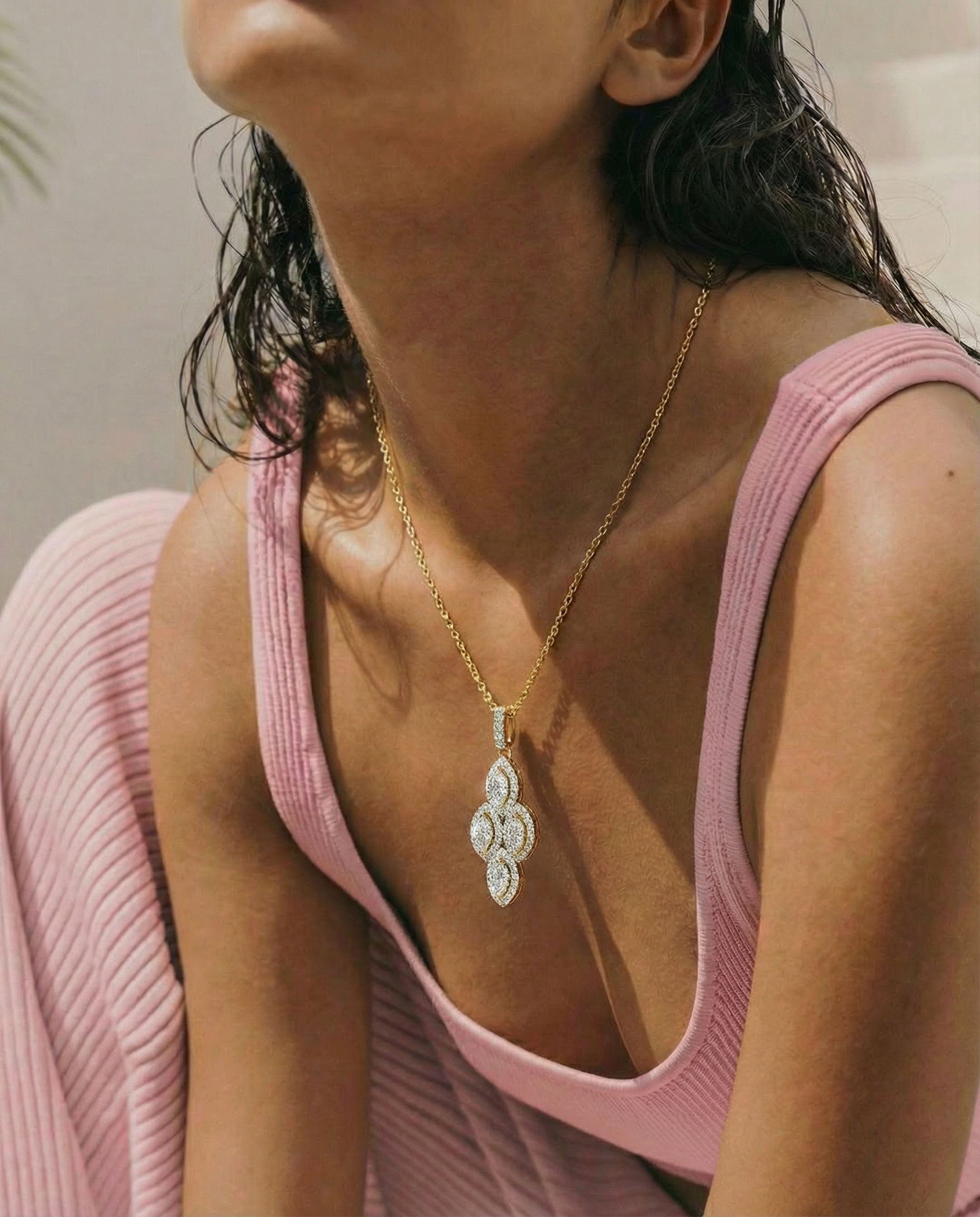
The biggest jewellery styling mistakes happen when every piece is beautiful on its own but nothing works together. Good jewellery style isn’t about following rigid rules. It’s about knowing what should lead, what should support and when your outfit has already said enough.
A jewellery faux pas rarely means your taste is wrong. More often, it means the proportions are fighting, the neckline has been ignored or too many strong pieces are competing for attention.
Here are five common mistakes and the easiest ways to fix them.
1. Letting every piece compete for attention
The most common jewellery styling mistake is wearing several statement pieces without deciding which one should be the focus.
A large necklace, long earrings, stacked bangles and a cocktail ring can all look excellent separately. Worn together, they may turn into visual noise. Your eye doesn’t know where to land.
Choose one hero piece first. Everything else should either support it or stay out of its way.
Hero piece | Keep the rest simple with |
Bare neckline or fine chain | |
Stud earrings and one ring | |
Small earrings or slim bracelet | |
Clean ring and light earrings | |
Simple studs and no competing necklace |
This doesn’t mean minimal jewellery is always better. It means every piece should have a role.
A pair of dramatic diamond earrings can handle the spotlight. They don’t need a necklace standing beside them, waving for attention.
2. Ignoring the neckline
Your neckline determines how much space a necklace has and whether it will improve the outfit or interrupt it.
A pendant that sits neatly inside a V-neck can look awkward over a high, embroidered collar. A short necklace may disappear against a busy blouse, while a long chain can cut across the clean line of a strapless dress.
The easiest approach is to treat the neckline and necklace as one composition.
Neckline | Jewellery that usually works |
High neck | Earrings, rings or a bracelet |
Deep V-neck | Pendant or graduated necklace |
Strapless | Tennis necklace or statement earrings |
Shirt collar | Fine pendant inside the open collar |
One shoulder | Earrings and bracelet |
Embroidered neckline | Studs or compact drops |
The jewellery doesn’t need to copy the neckline exactly. It should simply avoid fighting it.
A curved necklace can soften a square neckline. A sharp pendant can add structure to a round neck. Contrast often looks more considered than perfect matching.
3. Matching everything too perfectly
Perfectly matching jewellery can sometimes make an outfit feel less styled and more assembled from a box set.
The earrings, necklace, bracelet and ring don’t all need the same motif, metal colour or diamond shape. In fact, a little variation often makes your jewellery feel collected over time rather than chosen in one transaction.
You can wear yellow-gold hoops with a white-gold diamond ring. A rose-gold pendant can sit beside a yellow-gold watch. The diamonds create enough visual connection for the metals to coexist.
The same applies to motifs. Heart earrings don’t require a heart necklace and heart bracelet. One heart is thoughtful. Four may begin to feel like a themed event.
A good jewellery mix usually shares one element:
the same metal family;
a repeated diamond shape;
similar visual weight;
one shared design line;
a consistent level of sparkle.
Mixing is most successful when one detail connects the pieces.
4. Choosing jewellery for the occasion instead of the outfit
A common faux pas is deciding that a wedding requires heavy jewellery or that officewear requires tiny pieces, without looking at what the outfit actually needs.
A heavily embroidered lehenga may look better with diamond studs and one strong ring than with a full necklace set. A clean black dress can carry far more jewellery than its simplicity suggests. A white shirt may become the ideal background for a bold pendant or layered chain.
The outfit should guide the scale of the jewellery.
Outfit | Jewellery direction |
Embellished lehenga | Cleaner diamonds and fewer pieces |
Plain sari | Strong earrings or a statement necklace |
Tailored suit | Sculptural ring or sharp diamond drops |
Printed kurta | Simple studs or solitaire pendant |
Black dress | Tennis necklace or cocktail ring |
Everyday co-ord | Hoops, pendant or bracelet stack |
Think in terms of contrast. A busy outfit often benefits from clean jewellery. A simple outfit can carry something more expressive.
This is especially useful with Indo-western dressing. A modern vanki ring can add an Indian reference to a western dress, while a tennis bracelet can make a lehenga feel lighter and more contemporary.
5. Buying for a fantasy version of your life
The most expensive jewellery mistake is buying for the person you imagine you’ll become instead of the person who has to wear the piece.
You may admire heavy earrings but remove them after twenty minutes. You may love layered necklaces in photographs but wear high necklines most days. You may keep buying delicate rings even though what you really want is one bold piece.
Style becomes easier when you notice your real habits.
Before buying, ask yourself:
Will I wear this with clothes I already own?
Can I keep it on comfortably for several hours?
Do I own something very similar already?
Am I choosing it because I love it or because it feels safe?
Does it solve a gap in my jewellery collection?
Comfort is part of style. A ring that constantly spins, earrings that pull or a bracelet that catches on everything won’t become a favourite simply because the design looked good online.
Lab grown diamond jewellery can make it easier to choose the scale and diamond coverage you actually want. Lab grown diamonds are real diamonds with the same chemical, physical and visual properties as mined diamonds, created in a controlled environment rather than extracted from the earth.
A simple jewellery styling formula
The easiest jewellery styling formula is one focal piece, one supporting piece and enough empty space for both to be seen.
You can start with any of these combinations:
Main piece | Supporting piece |
Diamond earrings | Slim ring |
Tennis necklace | Small studs |
Cocktail ring | Fine bracelet |
Pendant | Simple hoops |
Diamond bangle | Solitaire ring |
Nose pin | Compact earrings |
This isn’t a fixed rule. It’s a reliable starting point when the jewellery box is open, the outfit is on and everything suddenly looks wrong.
You can always add another piece. Editing after you’ve left home is considerably harder.
Style works when the jewellery still looks like you
The best jewellery styling doesn’t make you look expertly accessorised. It makes the whole outfit feel more like you.
Avoiding a mistake isn’t about becoming cautious. It’s about giving your strongest pieces enough room to work.
Choose the focal point. Respect the neckline. Mix without overmatching. Dress the outfit you’re actually wearing, and buy for the life you actually live.
The rest is sparkle management.
Frequently Asked Questions
What is the most common jewellery styling mistake?
The most common jewellery styling mistake is wearing too many statement pieces at once. Choose one focal piece, such as bold earrings, a necklace or a cocktail ring, then keep nearby jewellery quieter. This creates a clear visual hierarchy and prevents each piece from competing for attention.
Is matching all your jewellery a fashion faux pas?
Matching every piece isn’t always a faux pas, but it can make an outfit feel overly coordinated. A more modern approach is to connect jewellery through one shared detail, such as diamond shape, scale or metal tone, while allowing the individual pieces to remain slightly different.
How do I choose jewellery for my neckline?
Choose jewellery based on the amount and shape of space around your neck. Deep necklines suit pendants, high necks work better with earrings, and embroidered necklines often need no necklace. The aim is to complement the garment’s line rather than cover or interrupt it.
Can I mix yellow gold and white gold jewellery?
Yes, yellow gold and white gold can be worn together. Keep the combination intentional by repeating one metal elsewhere or using diamonds as the common visual element. Mixed metals often make jewellery feel collected and personal rather than overly matched.
How many pieces of jewellery should I wear at once?
There’s no fixed number, but one hero piece with one or two quieter supporting pieces is a reliable formula. The correct amount depends on the outfit, jewellery scale and occasion. Three delicate pieces may feel lighter than one large necklace, so visual weight matters more than quantity.
What jewellery style works with a heavily embellished outfit?
Clean, compact jewellery usually works best with a heavily embellished outfit. Try diamond studs, a solitaire ring or a slim bracelet instead of a full matching set. The outfit already provides texture and detail, so simpler jewellery helps the overall look feel balanced rather than crowded.
Are lab grown diamonds suitable for everyday jewellery styling?
Yes, lab grown diamonds are ideal for everyday jewellery because they’re real diamonds with the same chemical, physical and visual properties as mined diamonds. They can be used in studs, rings, pendants and bracelets designed for regular wear, making them easy to build into a personal jewellery style.